At a Glance
A heavy bag looks like a garage item, yet plenty of people want one in a flat with thin walls and a landlord. The real question is rarely which brand to buy.
It is whether your walls, floor and neighbours can cope with the format you pick.
This guide compares a wall-mounted heavy bag with a freestanding one, works out the floor space each needs, and sets out what to check before you drill or order.
Wall bracket or freestanding: which heavy bag suits a small flat?
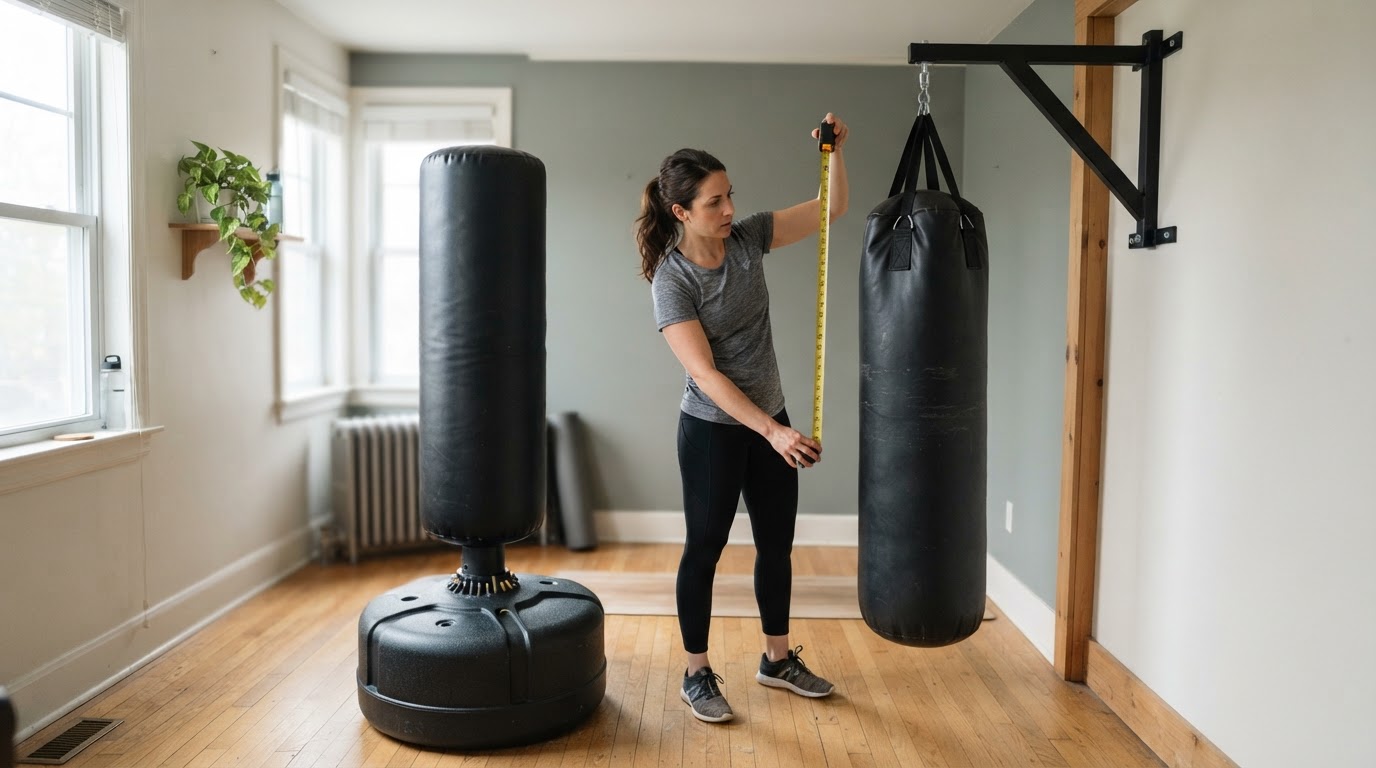
Two formats make sense in a flat. A hanging bag on a wall bracket, and a freestanding bag on a weighted base.
One retailer guide (MMA Warehouse, updated July 2026) notes that a freestanding bag avoids drilling into the building but still raises placement questions, such as a level base and room to move.
- Bag hangs and swings like a standard heavy bag
- Floor stays clear when the bag is not in use
- Needs a verified fixing point in the wall
- No drilling, so it suits many rented flats
- The base stays in the room permanently
- Can sway or creep if the base is not filled properly
The choice is easier once it becomes measurements for your own room, which is the next step.
How much floor space does a heavy bag need?
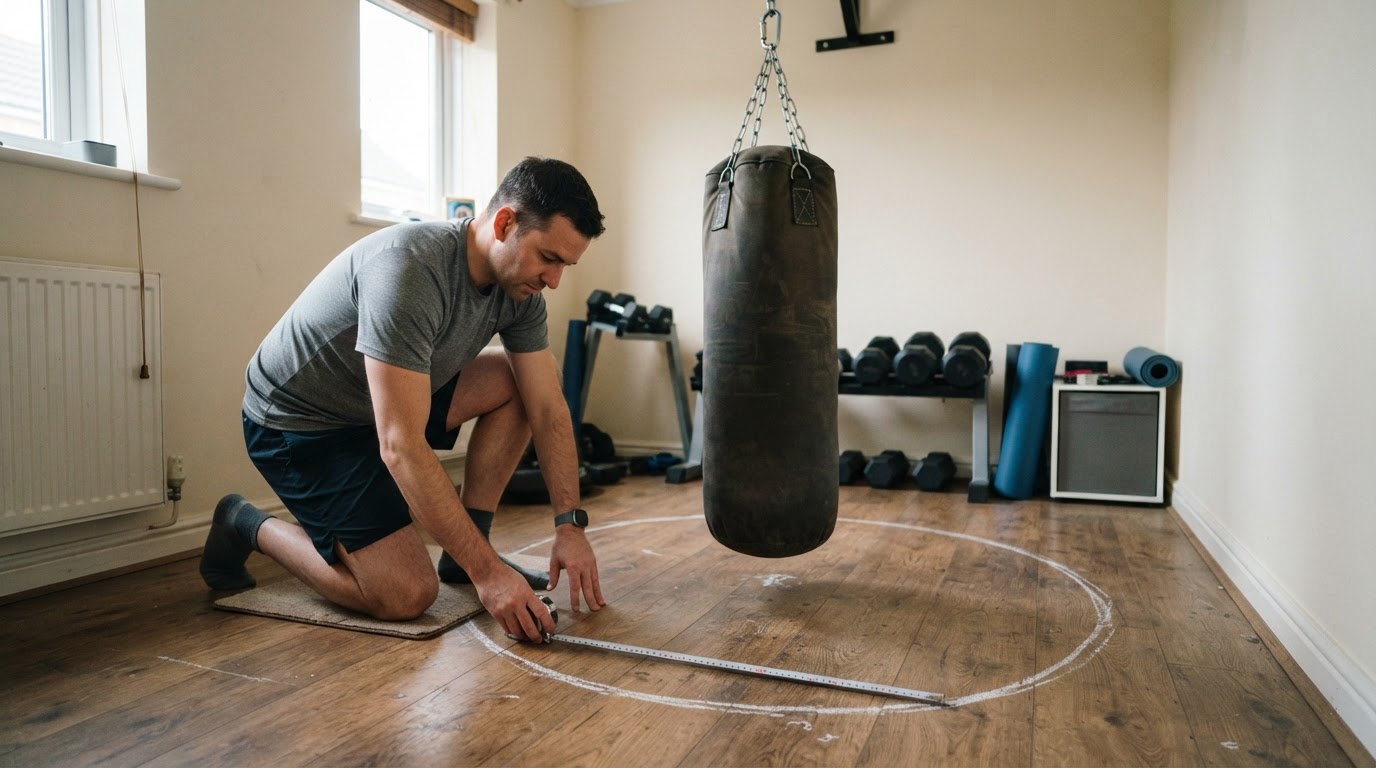
Measure the training zone, not the product photo, just as you would for any home workout equipment in a small flat.
The arithmetic is simple enough to do yourself.
Width needed = bag diameter + clear room on each side.
For a hanging bag, depth needed = bracket arm length + half the bag diameter + front clearance.
Illustrative example: a bag 35 cm across with 30 cm of room each side needs a zone about 95 cm wide. As a circle, that is roughly 0.71 m² of floor.
Height matters just as much. The space needed under the mounting point is the bag length plus the chain, swivel and hook drop.
| Setup | Floor zone while training | Floor zone when stored | Height to check |
|---|---|---|---|
| Wall bracket | Bag width + room each side, by arm length + half bag + front room | Close to nothing if the bag is unhooked or the arm folds | Bag length + chain and hook drop |
| Freestanding | Circle: base or bag width + room each side | The same circle, all day | Total bag and base height |
Mark the zone on the floor with masking tape and stand in it with your arms out. If a sofa arm or radiator sits inside the line, the bag is too big for the room.
Check the footprint of your own bag
This tool turns your measurements into a floor zone, a height check and a rough bag weight. The figures are your inputs, so swap in the real dimensions from the product page.
Can your walls and floor take a heavy bag?
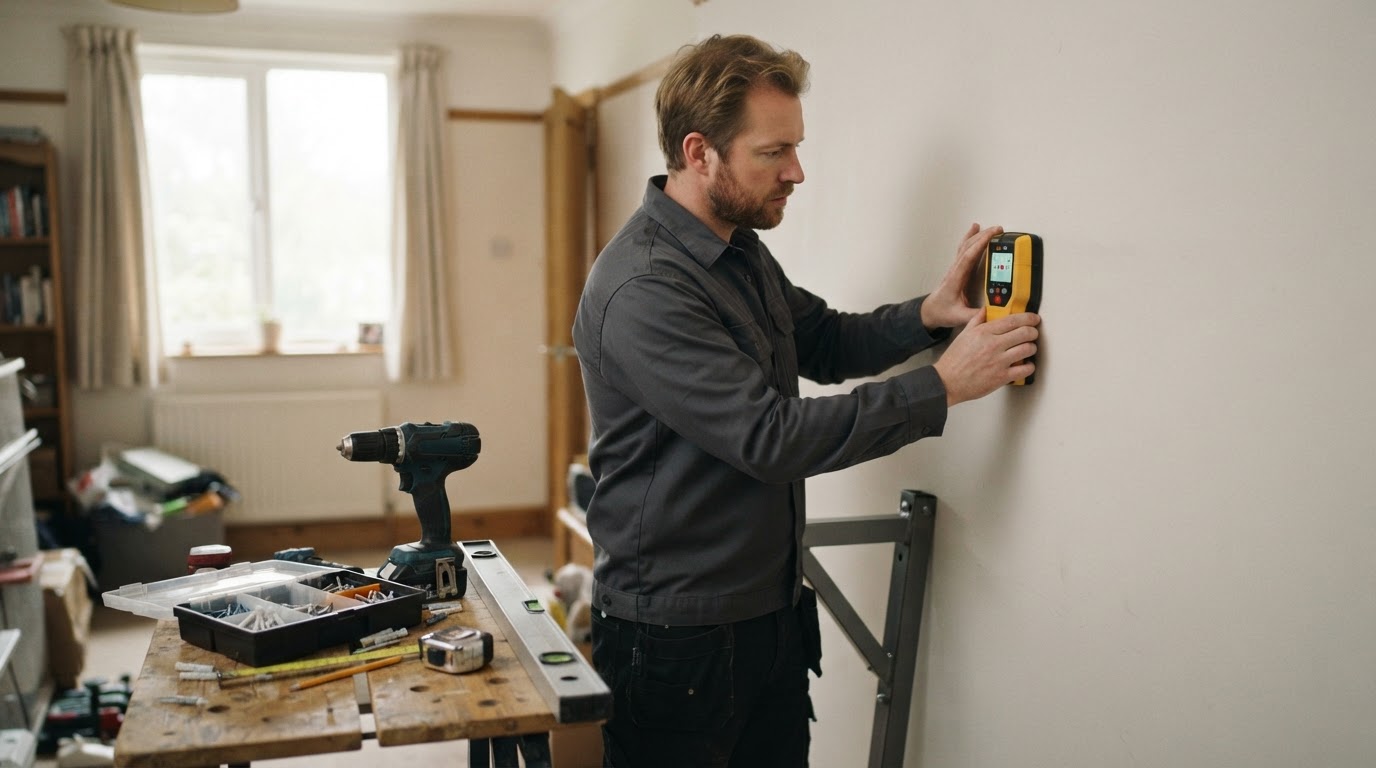
This is where most flat dwellers hit a wall, literally. A finished surface is not a structure.
The same retailer’s installation guide (MMA Warehouse, updated July 2026) says that drywall, plaster and cladding “do not carry the bag by themselves”. Plasterboard is the UK term for drywall.
A bracket has to bite into a verified structural member or an approved masonry surface, using fixings the mount manufacturer specifies.
A bag swinging on a bracket pulls and jerks, it does not just hang. Screws that hold a shelf can still tear out of plasterboard under that load.
If you rent, the same guide advises getting property approval before any drilling. It adds that “a neat patch later does not erase unauthorized drilling”.
Typical case: a tenant in a flat with plasterboard partition walls and no written permission to drill. A freestanding bag removes the whole question.
Typical case: an owner with a solid external wall. A bracket fixed with masonry fixings suited to that wall, and checked against the manufacturer’s instructions, becomes realistic.
For a ceiling mount, ask a qualified installer to confirm what the joists can take.
Filled or unfilled: how heavy should your bag be?
A rule of thumb that circulates in buying guides is to pick a bag at about half your body weight. For a 70 kg adult, that points to roughly 35 kg, or about 77 lb.
The half-your-weight rule ignores your discipline, experience and how the bag is mounted. Use it to shortlist, then adjust for how hard you actually hit.
Filled bags arrive ready to hang, with a known weight. Unfilled bags can cost less and let you set the weight and firmness, but you have to fill them evenly (Hayabusa buying guide, accessed November 2026).
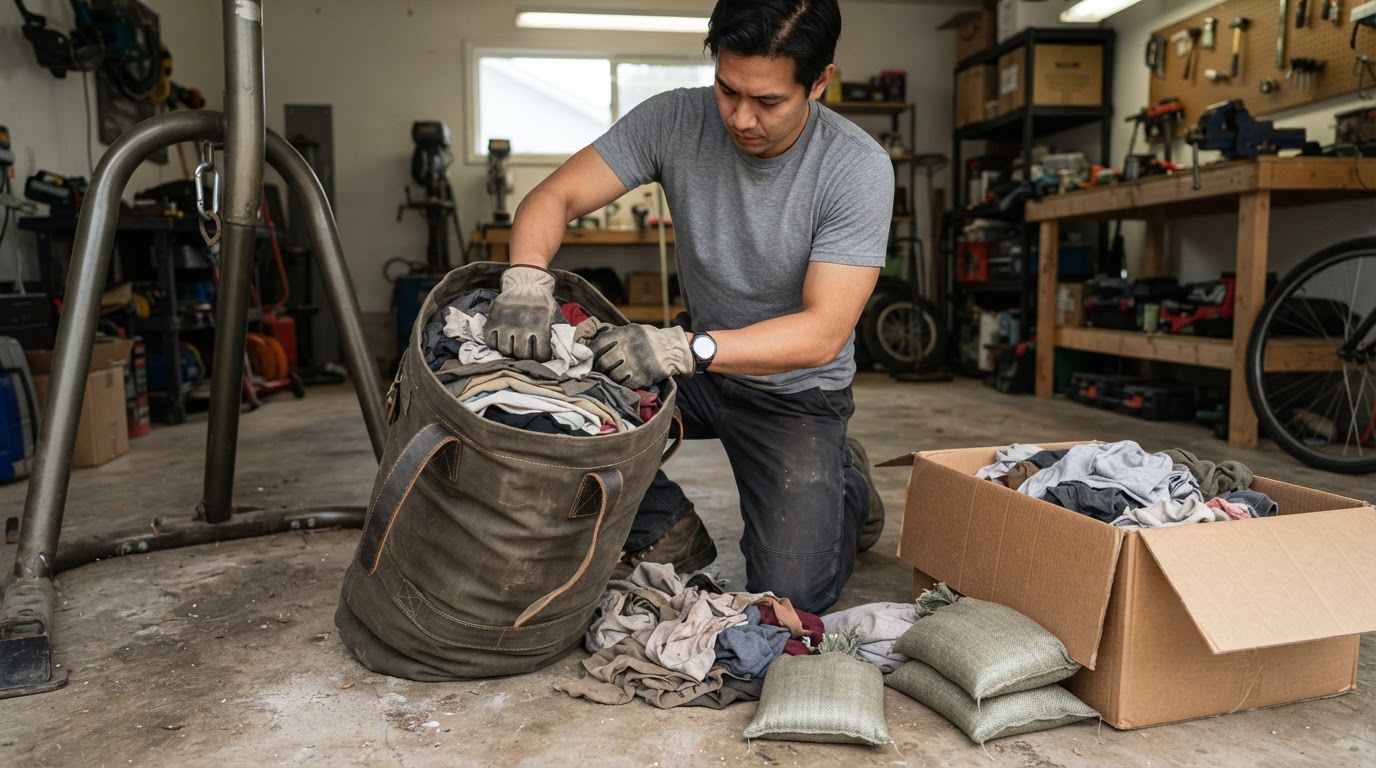
Filling is real work. Title Boxing’s stuffing guide (accessed November 2026) starts with 6 to 8 pieces of cardboard or foam, about 1 inch thick, taped together to form the base.
It then packs about 6 inches of clothing and adds sand in zip-lock bags, filling and packing every 10 to 12 inches. A gallon-size bag filled over halfway weighs about 5 to 6 lb, roughly 2.3 to 2.7 kg.
By that arithmetic, a 25 kg bag would need nine to eleven of those sand bags if sand supplied all the weight. Fabric and padding take some of that, but the sand and the filling time are costs a filled bag already includes.
If you cannot lift or store the filling material, a filled bag is worth the extra cost. Delivery costs can add to the price of a heavy bag, so compare the final price, not the sticker price.
What does a heavy bag cost in the UK?

Prices vary widely, and weight explains much of it. The table lists bags from one UK specialist’s collection page when checked in November 2026 (Rival Boxing UK).
Stock and prices may have moved since, and one bag was already sold out.
| Bag | Weight | Listed as | Price |
|---|---|---|---|
| Pro Heavy Bag | 25 kg (55 lb) | Heavy bag | £184.99 |
| Pro Heavy Bag | 38 kg (85 lb), sold out when checked | Heavy bag | £239.99 |
| Pro Heavy Bag | 50 kg (110 lb) | Heavy bag | £314.99 |
| Pro Heavy Bag | 68 kg (150 lb) | Heavy bag | £494.99 |
| Pro Heavy Bag | 90 kg (200 lb) | Heavy bag | £699.99 |
| Pro Free Standing Heavy Bag XL | 87 kg (191 lb) | Free standing | £799.99 |
The only free standing bag in that table costs £799.99, against £699.99 for the 90 kg Pro Heavy Bag on the same page.
That gap is the price of skipping the drill. For a tenant, it can still be the cheaper route once a landlord dispute is factored in.
Check whether chain, bracket or filling come with the bag, since the listing prices above are for the bag alone as shown.
The source for these prices is Rival Boxing UK’s heavy bag collection.
Will a heavy bag annoy your downstairs neighbours?
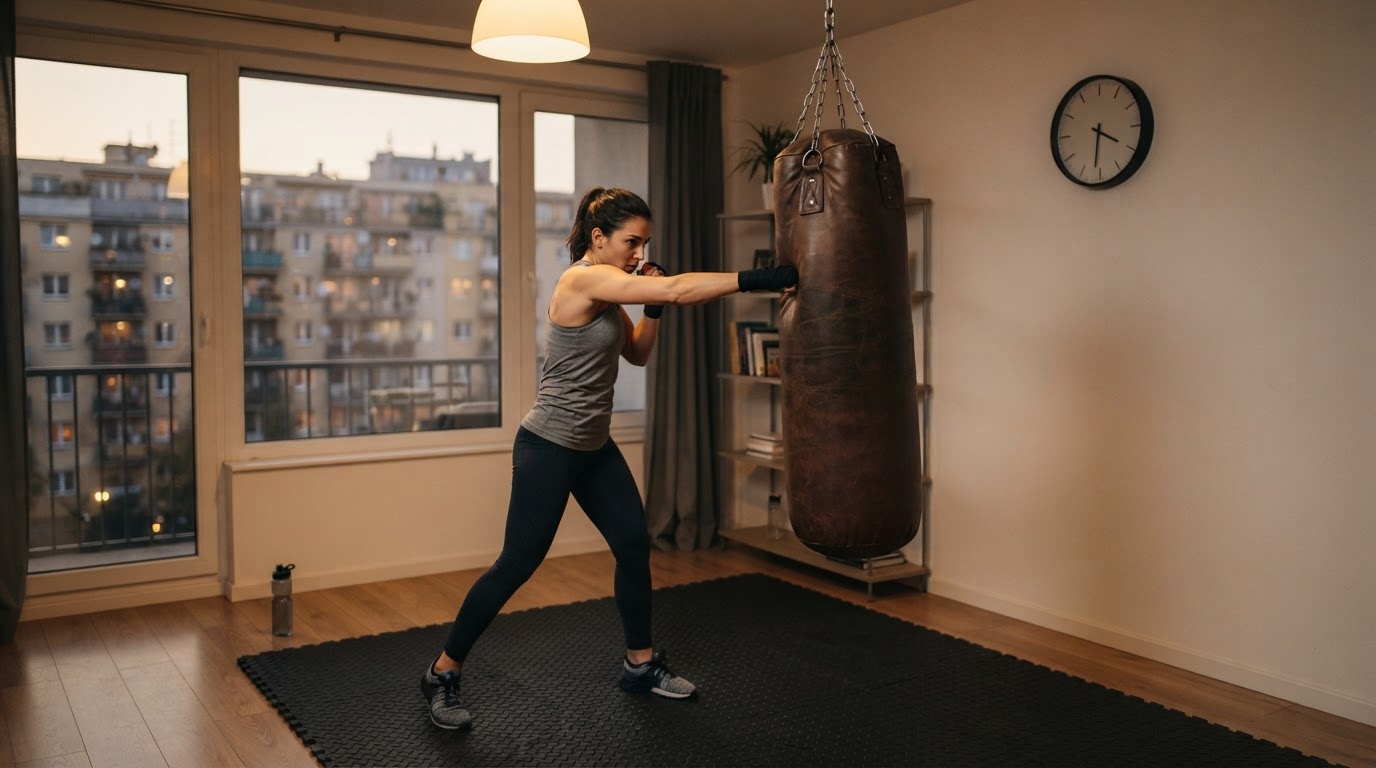
I found no published decibel readings for this. The small-space guide from MMA Warehouse (updated July 2026) has a section on noise and neighbours, but it gives no measurements.
That means any promise of a “silent” heavy bag is marketing, not data. What you can control is how the force reaches the building.
A thick rubber mat spreads the base load of a freestanding bag.
Training in normal waking hours matters more than any accessory.
A bracket sends every hit into the wall, so the quality of the fixing and the wall behind it decide how much you and your neighbours feel it.
Typical case: a first-floor flat with neighbours below. A freestanding bag on a mat, used at mid-morning or late afternoon, is the lower-risk start.
A mat under a bag cannot stop vibration that travels through a wall bracket. If a neighbour shares that wall, expect to hear it and be ready to talk first.
In Summary
For a rented flat with plasterboard walls, a freestanding heavy bag is the realistic choice. Measure the circle it needs and check the height before ordering.
If you own the flat and have a solid wall, a bracket saves floor space, provided the fixings suit the wall and the manufacturer’s instructions. Pick a bag near half your body weight as a starting point, then compare the full delivered price, not just the sticker.
Common Questions
Is a 50 kg heavy bag any good?
It suits heavier or more experienced users best, since 50 kg is about 110 lb and a lighter adult may find it stiff and slow to swing.
What is the difference between a punching bag and a heavy bag?
Punching bag is the umbrella term, covering speed bags and double-end bags too. A heavy bag is the long, heavy type that hangs from a mount or sits on a weighted base.