
At a Glance
Type “best resistance bands for home workouts UK” into Google and most results hand you a straight top ten list, ranked by star rating, with no real answer to the question that actually matters: which resistance level and band type suit where you are right now.
Bands are cheap, they pack into a drawer, and a single set can cover a full-body routine without a rack of dumbbells. The catch is that “resistance band” covers several genuinely different products, and picking the wrong one is one of the main reasons people give up on them within the first few weeks.
This guide breaks bands down by type, walks through how much resistance actually matches a beginner, intermediate or advanced lifter, and shows how they fit alongside a small-space home gym.
What types of resistance bands actually suit a home workout?
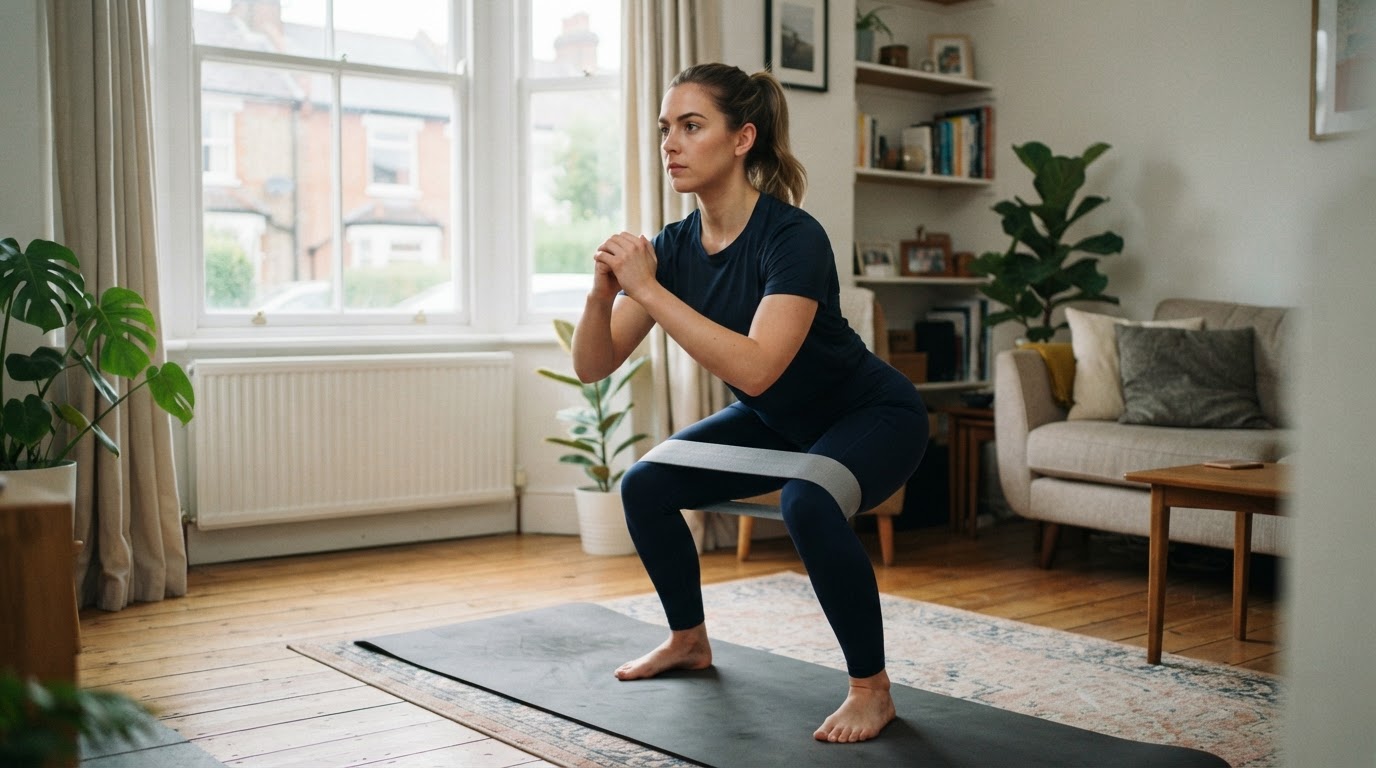
“Resistance band” gets used as a catch-all for four fairly different products, and mixing them up is the fastest way to buy the wrong one.
Loop bands are closed rubber circles, usually 30-50cm around. They sit flat against the skin without slipping, which makes them the standard choice for glute activation, hip abduction drills, banded squats and clamshells.
Fabric bands do the same job as loop bands but in a woven material instead of latex. They grip better against skin during hip thrusts and squat walks and are less likely to roll or pinch under load, though they cost more per band.
Flat (therapy) bands are long, flat lengths without handles, colour-coded by thickness. They give the most freedom of movement for full-body exercises and are the type most often used in physiotherapy settings.
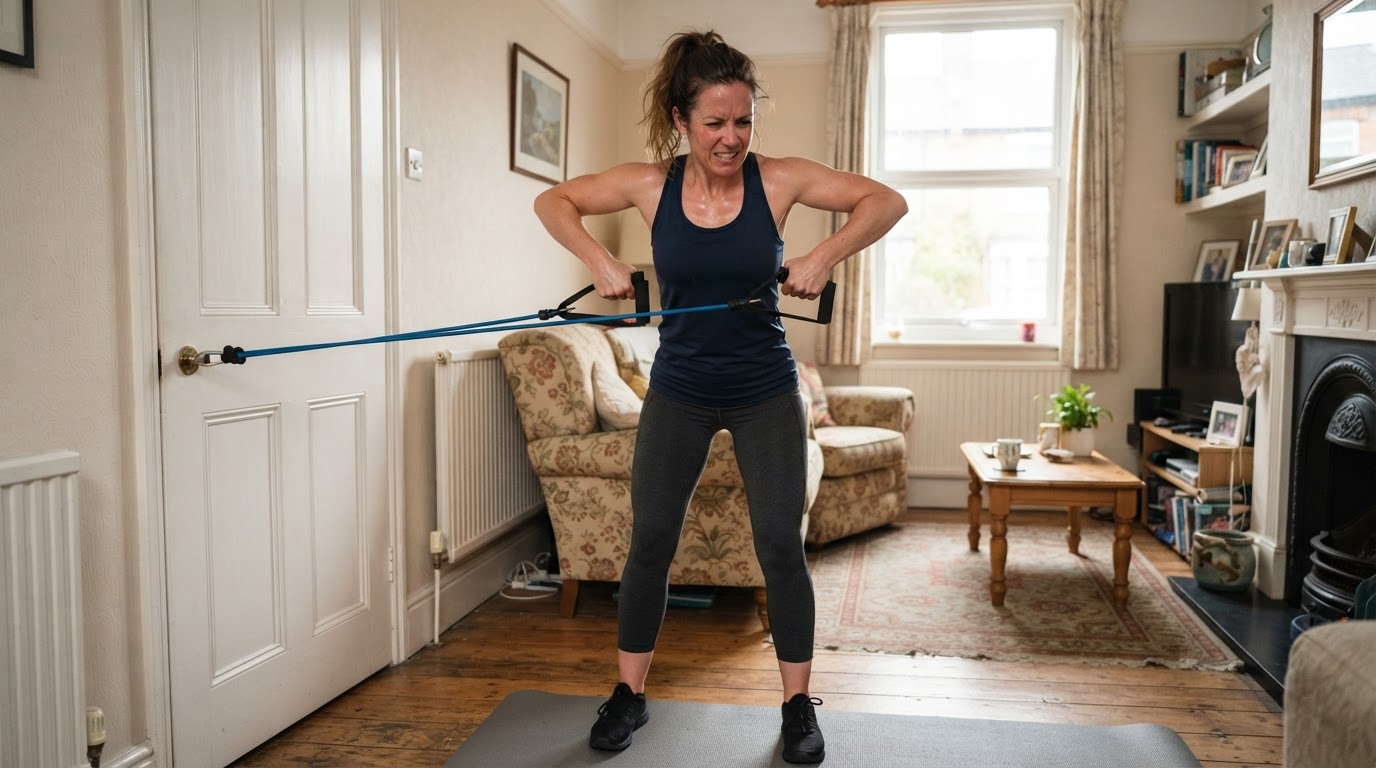
Tube bands with handles are rubber tubes with moulded grips, often sold with a door anchor and ankle cuffs. They mimic cable-machine movements like rows, presses and pull-downs, which makes them the closest thing to a “gym in a bag” for someone starting out.
- No setup, ready in seconds
- Best for lower-body and mobility work
- Cheap to build a small collection
- Limited for upper-body pulling movements
- Fewer resistance levels than a tube system
For a genuine full-body routine at home, most people end up owning at least two types: a loop or fabric set for lower-body and warm-ups, plus a tube-with-handles set for pressing, rowing and pull-down patterns.
How much resistance do you actually need to start with?
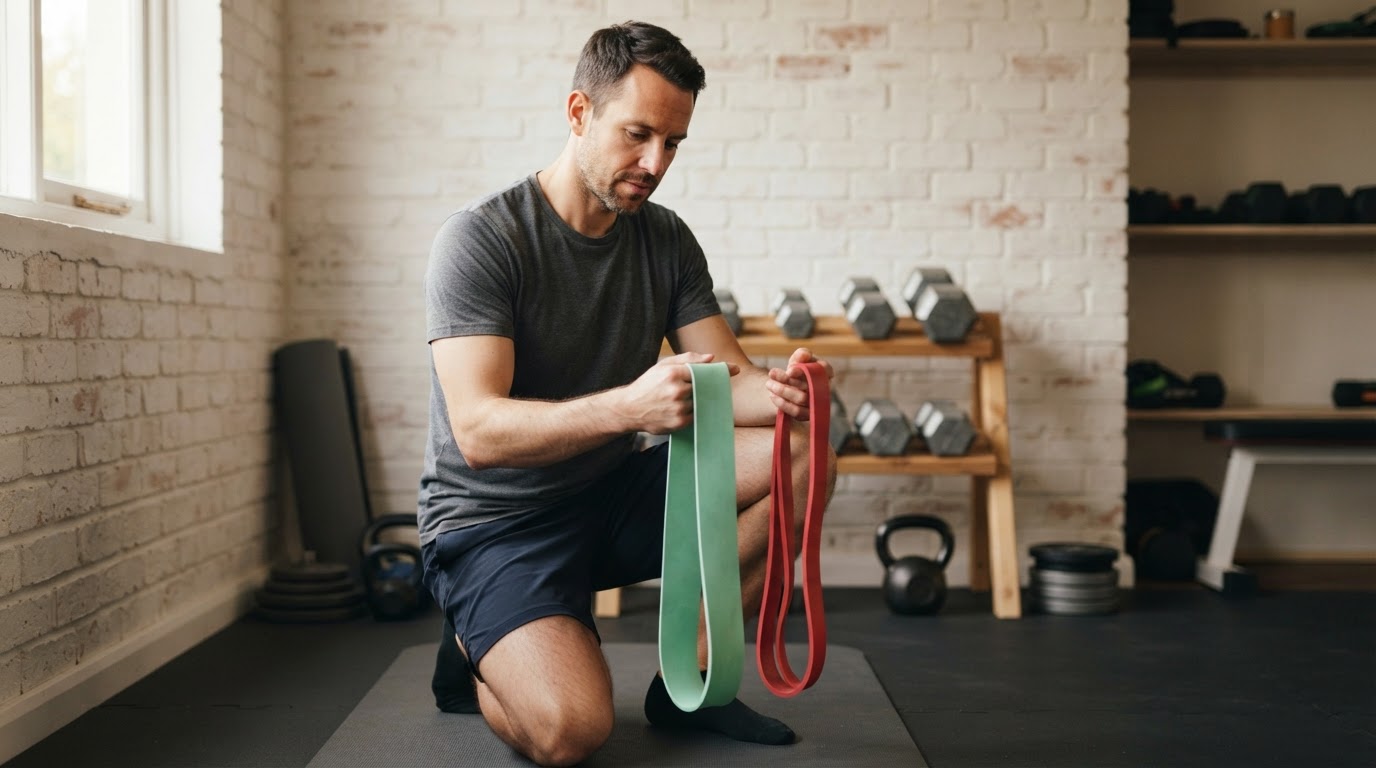
This is the question most buying guides skip entirely, and it matters more than which brand sits at the top of a review list.
UK retailers roughly group resistance into three bands (no pun intended): around 5-15kg for light bands, 15-35kg for medium, and 45-60kg or more for heavy, based on current Decathlon and Argos listings. The common colour convention runs yellow (extra light) through red, green, blue, to black (extra heavy).
| Fitness stage | Typical resistance | Common colour | UK example |
|---|---|---|---|
| New to resistance training | 5-15kg | Yellow / red | Meglio flat band set, from £3.99 |
| Some strength training behind you | 15-35kg | Green / blue | Decathlon Domyos band with handles, around £15-£18 |
| Regular lifter wanting a real challenge | 45-60kg+, or stacked tubes | Black / stacked | Bodylastics stackable set, £25-£35, combines up to roughly 80kg |
Resistance figures are not standardised between brands. A “green” band from one manufacturer can pull noticeably harder than another maker’s green band, because stretch length and band width both change the actual force. Always check the specific kg or lb rating printed on the band rather than assuming colours line up across brands.
Which resistance level suits you?
How long have you been doing any kind of strength training?
What do you mainly want to train?
Testing a six-band latex set built for more experienced lifters, Men’s Fitness found the bands “felt seriously robust on test”, noticeably thicker than budget alternatives, with the range running from around 15lb at the lightest grey band to over 200lb at the heaviest black band.
Do resistance bands really build muscle, or are they just for warm-ups?
Bands get dismissed as a warm-up tool, but the research doesn’t back that up cleanly.
A study measuring resisted, assisted and free-weight deadlifts in resistance-trained men found that both elastic band conditions produced higher peak force than free weights alone, with no significant difference in muscle activation across the gluteus maximus, hamstrings, erector spinae and quadriceps between any of the three variations.
Free weights still edge ahead for maximal strength and for keeping consistent tension through a full range of motion, since a band pulls hardest only once it’s stretched. In practice, this means bands are genuinely effective for building strength and muscle, particularly in the second half of a movement, but they’re not a like-for-like swap for a barbell if outright strength is the specific goal.
If you already own some dumbbells, loop a band around the bar or your wrists during presses and squats. Combining bands with free weights adds resistance exactly where a barbell alone goes slack at the top of the movement, which many lifters and coaches find more effective than using either tool on its own.
Which bands make sense for a small UK flat home gym?
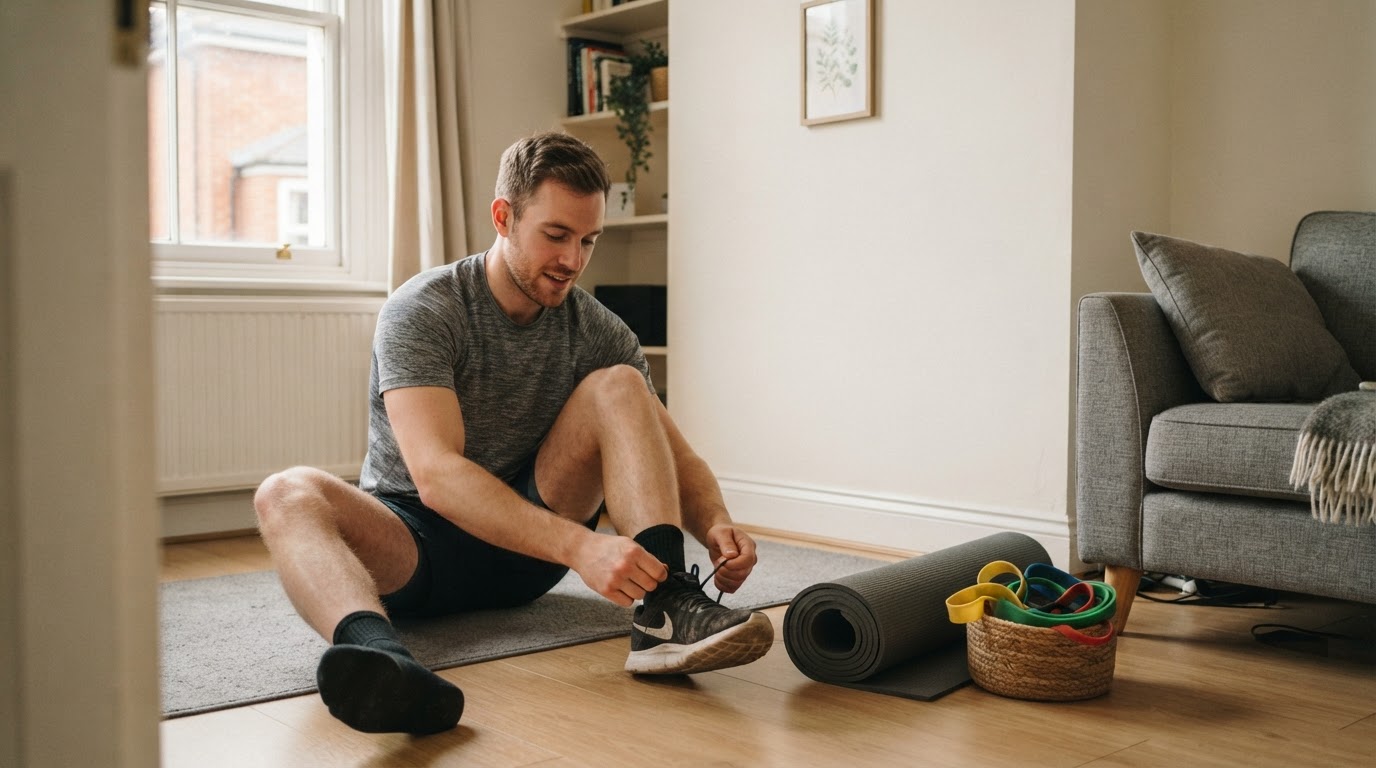
Bands are one of the few pieces of kit that genuinely solve the space problem renters and flat-dwellers deal with, and they pair naturally with a wider small-space setup.
A tube set with a door anchor needs a solid door frame and around a metre of clearance behind you, so check the door swings the right way before buying. Loop and fabric bands need no anchoring at all, just floor space the size of a yoga mat, which makes them the easier first purchase in a shared flat where wall or door fixings aren’t an option.
Storage-wise, a full band set (loop, fabric and tube types together) still fits in a shoebox-sized bag, unlike dumbbells or a bench, which makes it the natural first addition to a small-space home gym built around footprint rather than machines.
Before anchoring a tube band to a door, wedge the door anchor on the opposite side from where you’ll pull, close the door fully, and give the band a firm test tug at low resistance first. A door that isn’t fully latched is the most common cause of a tube band recoiling back at speed.
How do you progress to the next resistance level without hurting yourself?
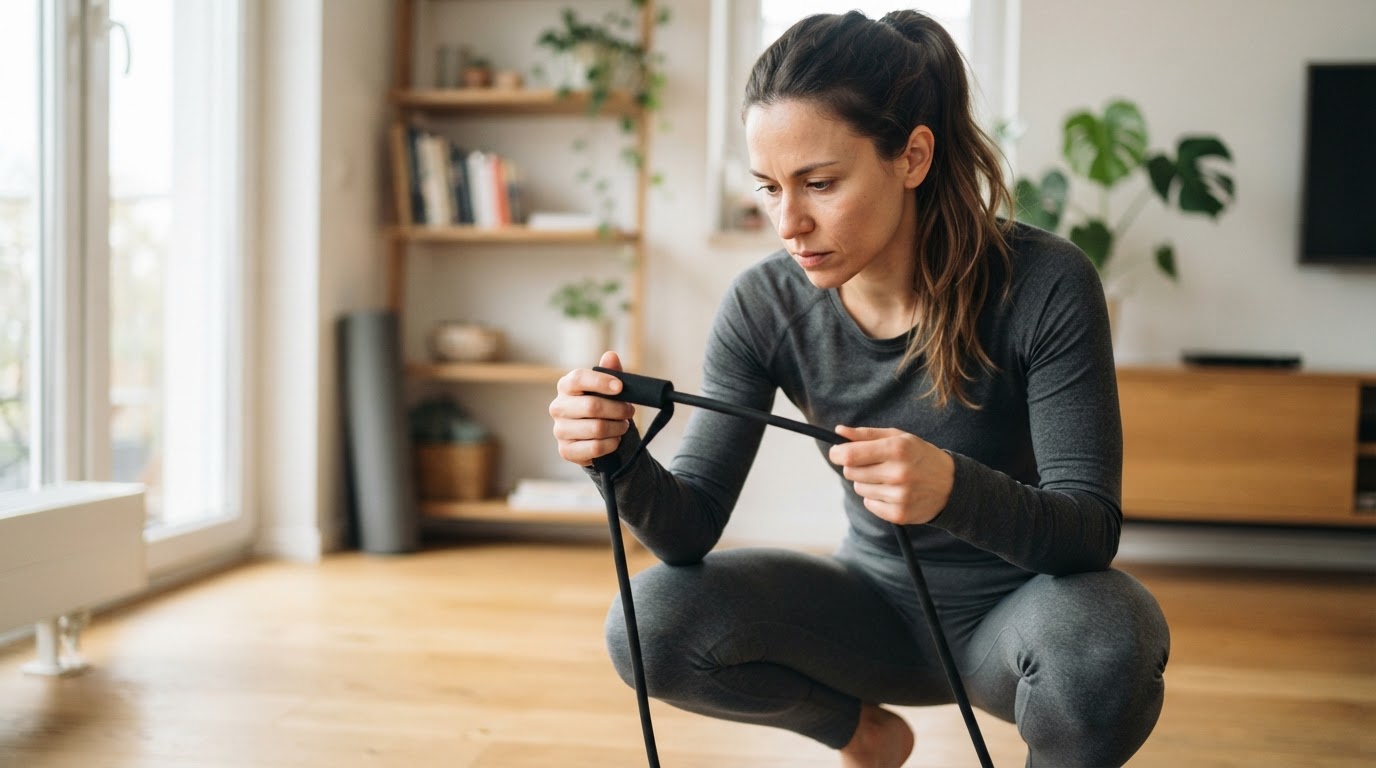
The most common mistake isn’t buying the wrong band, it’s staying on the same one for months out of habit.
A reasonable rule: once you can complete 15-20 controlled reps of an exercise with good form and the band still feels manageable at the last few reps, it’s time to move up a level, whether that means a new colour or stacking an extra tube. Moving up while form is still breaking down under fewer than 10 reps usually means the jump is too big for that particular movement.
Bands degrade with UV light, heat and repeated stretching well past their rated length, and a worn band is the main safety risk with this kind of kit.
Inspect latex bands for small nicks, thin patches or discolouration before every session, and replace one as soon as you spot any of these, rather than waiting for a snap. Storing bands away from direct sunlight and radiators noticeably extends how long they last.
In Summary
The type of band matters less than matching resistance to where you actually are: light loop or flat bands to learn movement patterns, medium bands once the basics feel easy, and a stackable tube system once a single band stops being a challenge.
Bands hold up well against free weights for muscle activation, particularly combined with dumbbells rather than used alone, and they solve the space problem that stops a lot of people training at home in the first place.
Buy one type to start (loop or tube, depending on whether lower or upper body is the priority), get the resistance level right using the table above, and add a second type once the first genuinely feels too easy.
Do resistance band workouts really work?
Yes, for building strength and muscle, particularly when the resistance level matches your training stage. Research on resisted and assisted movements shows bands can produce force comparable to or higher than free weights in parts of a movement, though free weights still hold an edge for maximal strength.
Can you build a full-body workout with just resistance bands?
Yes, as long as you own more than one type. A tube set with handles covers pressing and pulling movements, while a loop or fabric band covers lower-body and glute work that a tube alone doesn’t do as well.
How long do resistance bands typically last before you need to replace them?
It depends heavily on use and storage rather than a fixed timeframe. Latex bands used several times a week and kept out of direct sunlight commonly last a year or more, while a band left stretched, in heat, or exposed to UV light can weaken within months. Checking for nicks or thinning before each session matters more than counting months.
Should you buy a full resistance band set or individual bands?
A set makes more sense for most people starting out, since it covers a range of resistance levels for less than buying each one separately. Individual bands are worth adding later, once you know exactly which resistance level a specific exercise needs.
Can beginners get injured using resistance bands at home?
The main risks are a worn band snapping or a door anchor releasing under tension, both avoidable by inspecting the band before use and testing a door anchor at low resistance first. Compared with free weights, the injury risk from the resistance itself is low, since a band offers no risk of dropping a weight.