At a Glance
A curved treadmill looks like a neat answer for a small flat: no motor, no plug for the belt and very little to service.
The catch is that it is heavy, large and tiring to use, and the noise question is less simple than the marketing suggests.
This guide works through the floor space, the noise your neighbours may hear and the real UK cost, then ends with a checker for your own room.
What is a curved treadmill, and why does it appeal in a small flat?
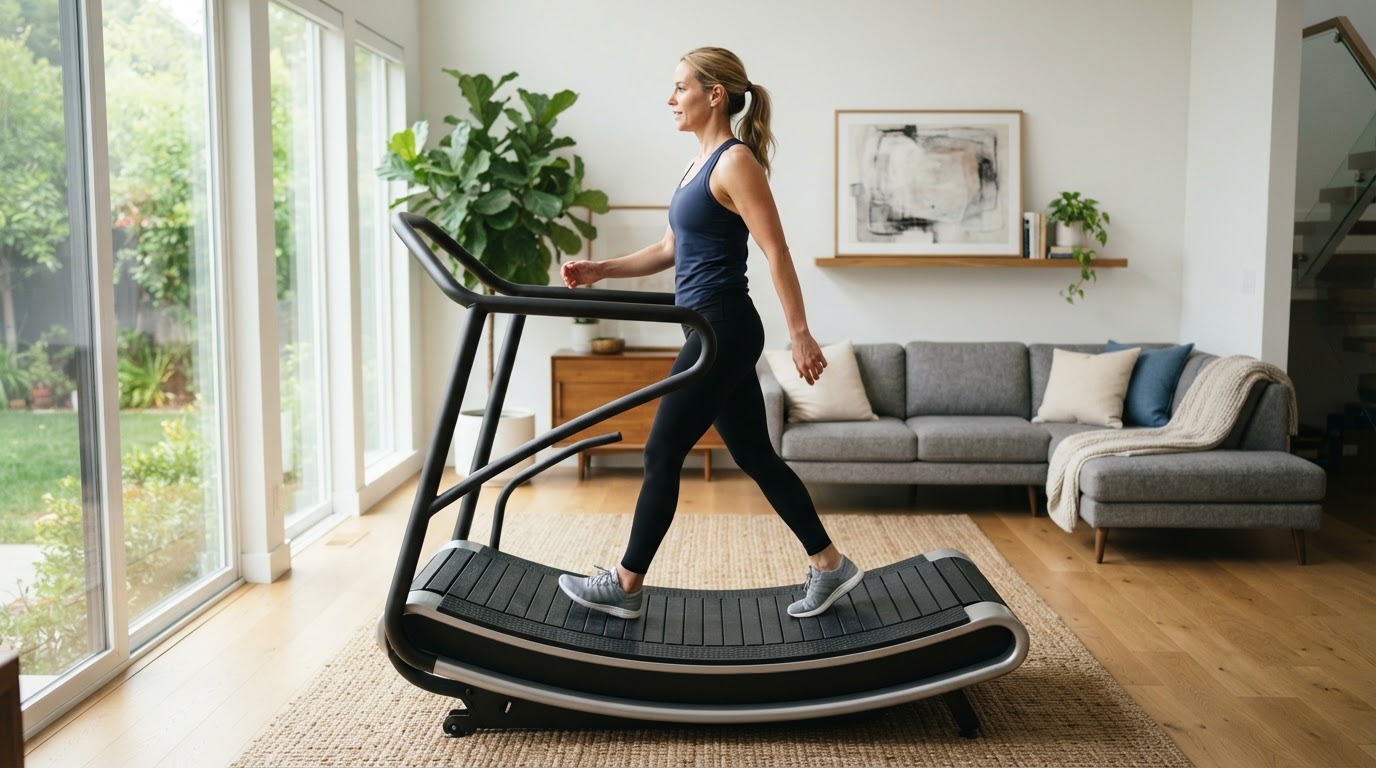
A curved treadmill has a slatted belt that sits on a curved frame. You drive the belt with your own steps, so it has no motor and your effort sets the speed.
That design explains the appeal for a flat. There is no motor hum, no need for a dedicated socket to run the belt and, according to Verve Fitness (a retailer that sells both curved and motorised machines, so a vendor view, accessed November 2026), very little to service beyond the belt and bearings.
The same design explains the drawbacks.
The machine is built for effort, it is large for its running length, and very few fold.
Self-powered does not mean entirely plug-free. The belt needs no electricity, yet the display may, so check how a specific model runs its console before you order.
Three questions decide whether it suits a flat: how much floor it takes, how loud it is for the people below and what it costs in total. The sections below take them in that order.
How much floor does a curved treadmill take in a small UK flat?
Most guides quote the running deck, not the whole machine. According to Fittux (19 August 2026), these are the deck sizes:
- SOLE C80: 19 × 62 in, about 48 × 157 cm
- SB Fitness CT400: 18 × 60 in, about 46 × 152 cm
- SB Fitness CT700: 19 × 66 in, about 48 × 168 cm
The frame, side rails and console add to those figures, and the overall size is not given on those pages. The overall length and width on the manufacturer spec sheet are the numbers to use.
Weight matters as much as size, and according to Home Gym Verdict (updated 9 August 2026), curved machines generally weigh 280 to 330 lb, about 127 to 150 kg, with one model at 415 lb, about 188 kg.
Home Treadmill (3 August 2026) puts it as “often 150 kg or more” and notes that very few fold. A machine like that is delivered once and stays where it is placed.
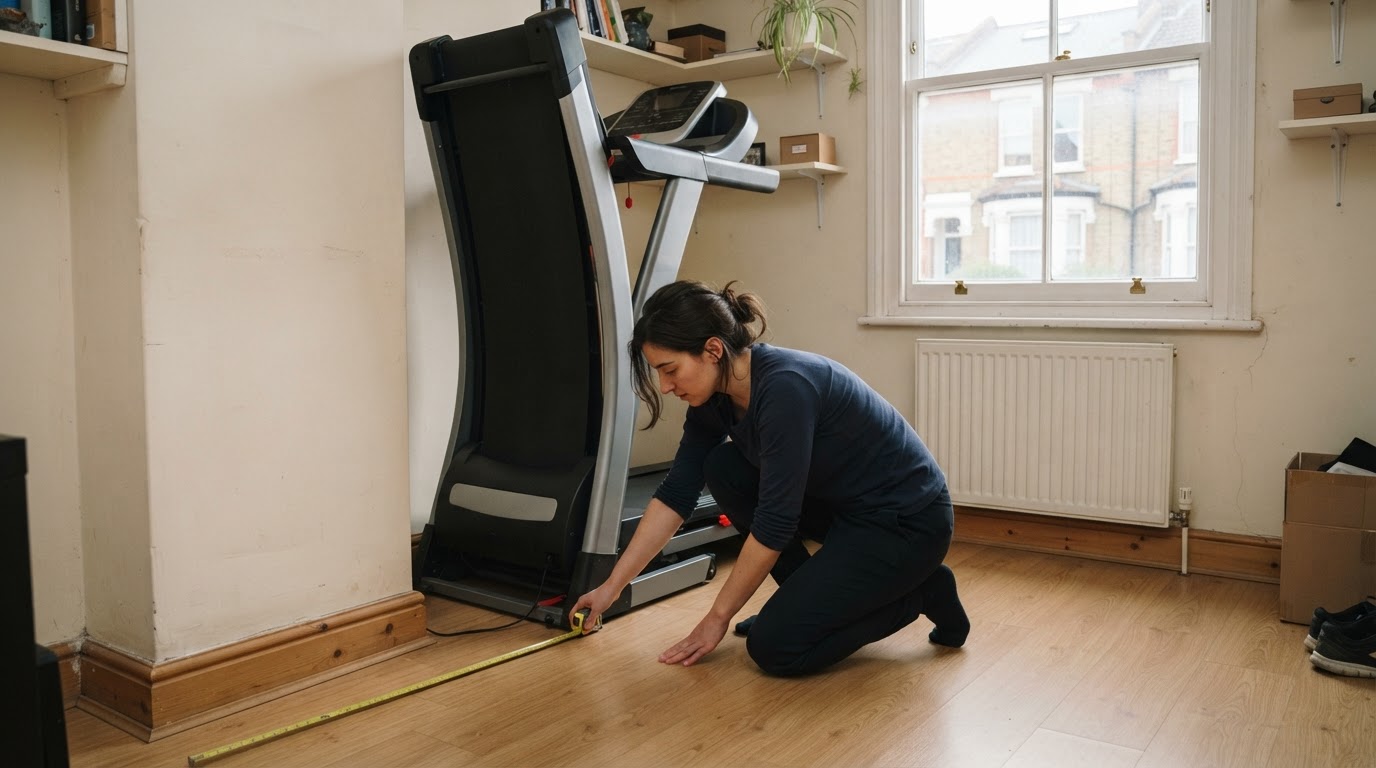
Measure the route in as well as the room: front door, hallway corners, stair turns and the lift if there is one. Then ask the seller who carries it upstairs, because freight for large machines can change the price (Fittux, August 2026).
Typical case, with invented figures for illustration: a spare room of 260 × 340 cm and a machine listed at 190 × 80 cm overall. That leaves 180 cm of width beside it and 150 cm of length behind it, before any rear clearance.
Whatever clearance the manufacturer asks for comes out of that 150 cm, and it is the figure most buyers forget. The checker further down does this subtraction for you.
Is a curved treadmill quiet enough for a flat with neighbours below?
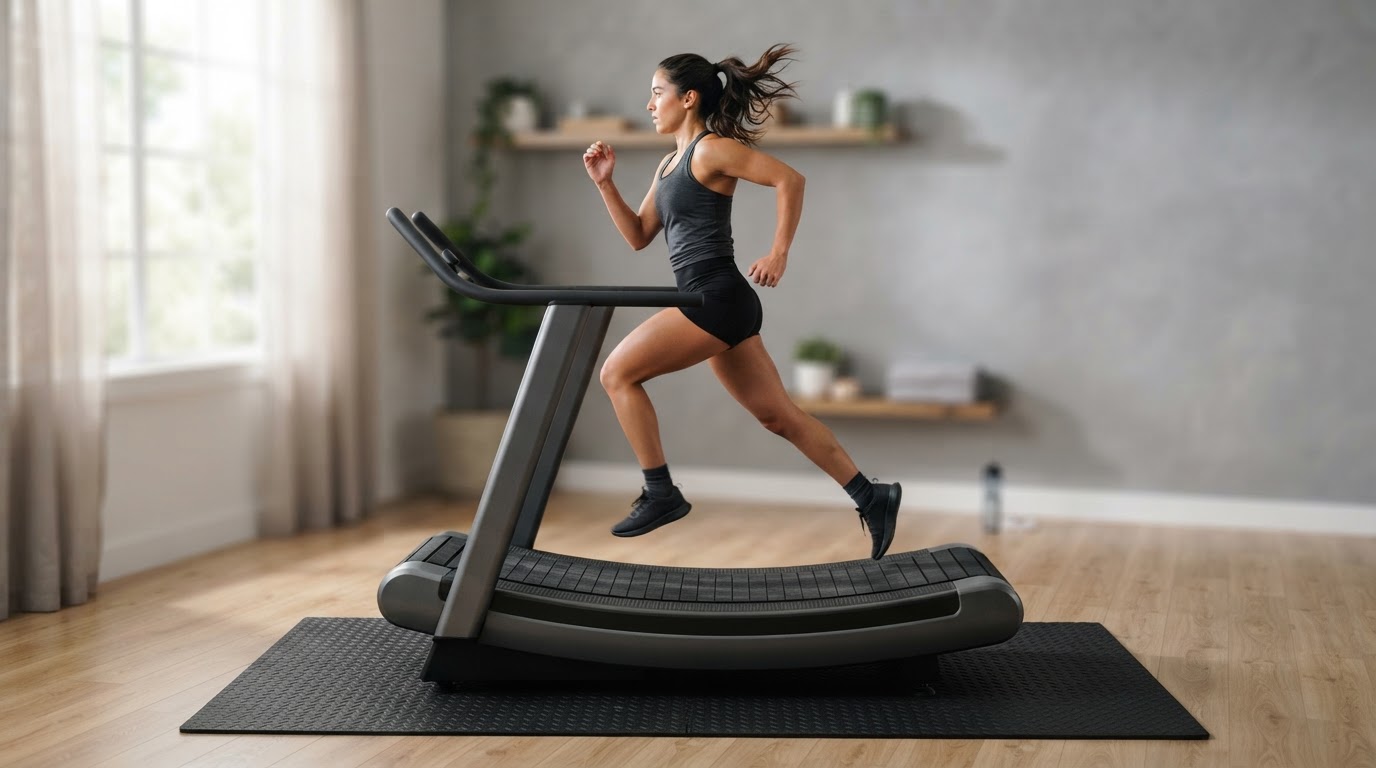
Partly. Without a motor, the machine makes less airborne noise. BarBend measured the AssaultRunner Elite at 28.2 dB, against 35 to 37 dB for three motorised treadmills, according to Home Gym Verdict (9 August 2026).
That is a gap of roughly 7 to 9 dB, and it is measured near the machine. The neighbour below hears something different: the thump of each foot strike through the structure.
Fittux makes the same point, noting that the belt and your foot strikes still create sound. For that reason, Home Gym Verdict recommends a mat.
No UK test of curved treadmills for flat-neighbour noise turned up at the time of writing, so the best evidence is indirect. In a Mumsnet thread dated 31 August 2019, which does not say whether the machine was motorised or manual, one poster wrote:
“At first, the treadmill was upstairs but despite a thick rubber mat it, the whole house shook.”
In the same thread, the original poster in a new-build flat said they could still hear a stomping sound through two layers of foam mats and a rug.
The 28.2 dB reading comes from one reviewer testing one premium model. It says little about a budget curved machine, and nothing about vibration into the flat below.
A few habits reduce the risk, whichever type you buy:
- Read the tenancy or lease, and tell the downstairs neighbour before the machine arrives.
- Put a thick mat under it, and treat it as a reducer, not a cure.
- Agree times that suit them, as one poster in the same thread suggested.
If the flat has a choice of rooms, a ground-floor or solid-floored room beats an upstairs bedroom. The same Mumsnet poster fixed the shaking by moving the machine to a concrete floor downstairs.
How much does a curved treadmill cost in the UK once everything is added?

The sticker price spans a wide range, and Home Treadmill (3 August 2026) groups UK models into three bands:
| Band | Typical UK price | Models named |
|---|---|---|
| Budget | £500 to £1,500 | Imported and lesser-known brands (no models or prices given) |
| Mid-range | £2,500 to £4,000 | Assault Runner, TrueForm Runner |
| Premium | £6,000 and above | NoHRD SprintBok (close to £6,000), Woodway Curve (around £9,900) |
These bands are one guide’s view from August 2026, and sale prices move. Recheck the retailer’s current price and delivery charge before you order.
The extras sit outside those bands: delivery for a machine of this weight, a mat, and any local servicing.
Fittux also suggests confirming warranty cover and whether replacement slats can be bought in the UK.
Typical case, with an invented figure for illustration: a £3,000 machine spread over five years costs £600 a year before extras. The checker below does this sum with your own prices.
Check your room and your total cost in one go
This tool compares your room with the machine you are considering, and adds delivery and a mat to the price. It uses only the measurements and prices you enter, so take the overall size from the spec sheet.
Room and machine (in centimetres)
Cost (in pounds)
Who should skip a curved treadmill and choose a walking pad or motorised model?
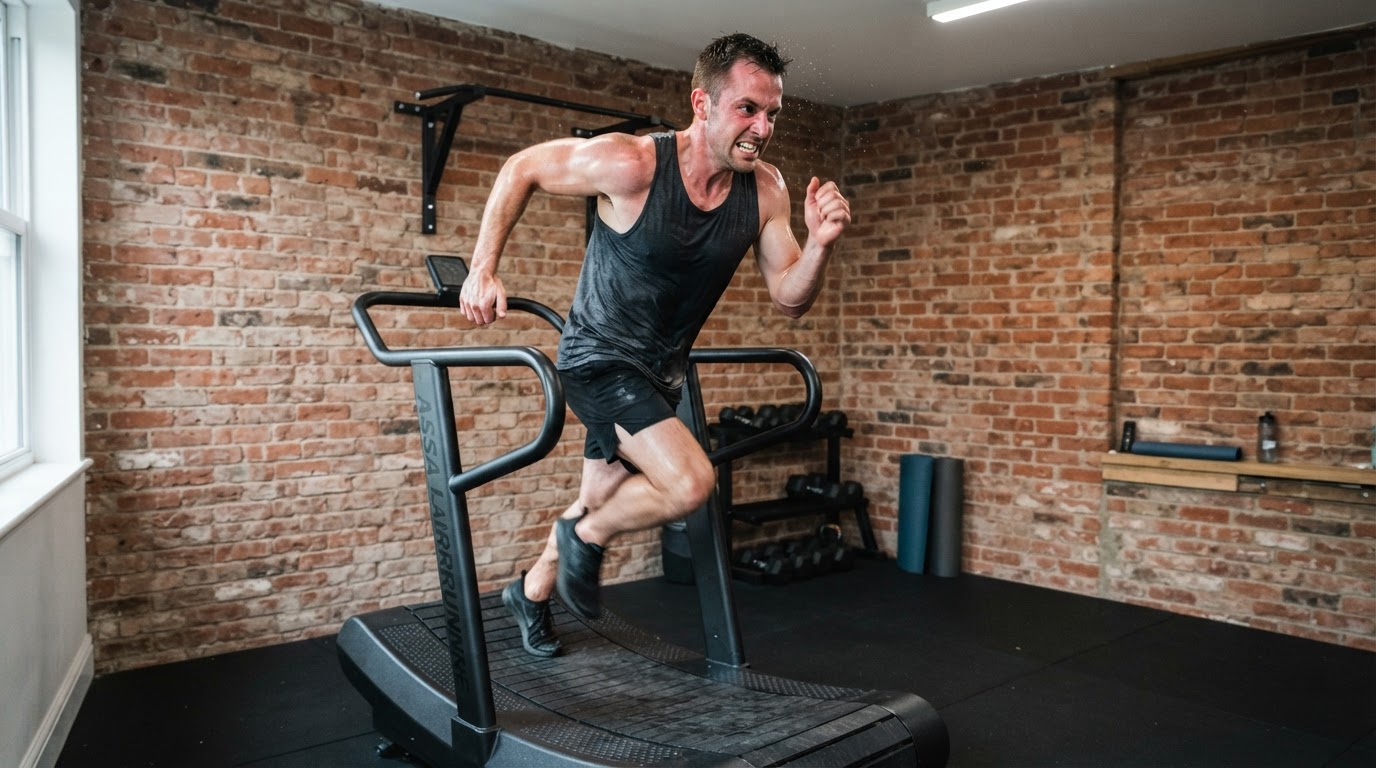
At the same speed, a curved treadmill is harder work, according to Edwards and colleagues in Frontiers in Physiology (14 November 2017), who tested 14 trained runners and found oxygen demand about 16 percentage points higher than on a motorised treadmill, and heart rate about 22 beats a minute higher.
A 2018 follow-up in the Journal of Science and Medicine in Sport, with 13 trained male runners, found a similar pattern. For intervals and sprints that is the point, but for easy walking it is a poor trade.
Home Treadmill reaches the same conclusion, saying casual or walking-focused buyers are usually better served by a motorised treadmill or a walking pad.
The “30% more calories” line should not drive the purchase either, because Home Gym Verdict says it started as a manufacturer claim, not a study result.
- No motor, so less airborne noise
- Belt needs no electricity
- Speed follows your effort, which suits intervals
- Little to service
- Heavy, often 150 kg or more, and rarely folding
- Footfall still reaches the floor below
- Harder than a motorised belt at the same speed
- High price and delivery cost
In Summary
A curved treadmill can work in a small UK flat when the room is measured, the floor is solid or well matted and the buyer wants hard intervals, not gentle walks.
It is quieter in the air than a motorised model, but the thump through the floor is the part neighbours notice. For a walking routine, a walking pad or a motorised machine is the more realistic choice.
Common Questions
What is a SkillMill, and is it the same as a curved treadmill?
A SkillMill is Technogym’s curved machine, aimed at performance gyms and described by Home Treadmill (3 August 2026) as doubling as a sled-push trainer. It follows the same self-powered idea, but Home Treadmill puts its price above even the Woodway Curve, so it is rarely the sensible pick for a flat.
Does a curved treadmill have an incline setting?
Usually not. The fixed curve is part of the design, and Verve Fitness (which sells both curved and motorised machines, so a vendor view) states that curved treadmills have no incline adjustment. That matters if hill work is important to you, so check each model’s specification.