
At a Glance
A power bank is one of the smallest items in a travel bag, but the wrong one can mean a dead phone in an unfamiliar city.
The right capacity depends on the trip. A weekend city break needs far less charge than a week juggling a phone, a camera and a laptop.
UK airlines also enforce their own rules on lithium batteries, and these were tightened as of 27 March 2026 under UK Civil Aviation Authority guidance.
This guide covers the best portable chargers for UK travel that holidaymakers and commuters can actually rely on, matched to the trip ahead rather than a single “best overall” pick.
What size power bank do you actually need for travel?

Capacity is usually printed in mAh (milliamp-hours), a measure of stored charge rather than the energy a device actually receives.
Most phones need between 3,000 and 5,000mAh for a full charge, so a 10,000mAh power bank typically covers two full phone charges with some loss along the way.
A model that also needs to top up a tablet, wireless earbuds or a camera across several days needs considerably more headroom.
Advertised capacity is measured at the battery’s internal voltage (around 3.6-3.7V), not at the 5V a phone charges from. A fully charged 20,000mAh power bank delivers noticeably less than 20,000mAh through its USB port, because of that voltage conversion and normal energy loss as heat.
Aisha is flying from Manchester to a five-day conference in Berlin with a phone, wireless earbuds and a USB-C laptop. For that trip, a power bank closer to 25,000mAh with at least 65W output keeps the laptop usable between sessions, where a basic 10,000mAh model would run out by the second day.
A simpler use case, like Tom’s weekend trip to Edinburgh with just a phone and a set of earbuds, is well served by a 10,000-15,000mAh model that fits in a jacket pocket.
| Trip type | Recommended capacity | Roughly in Wh | Best for |
|---|---|---|---|
| Day trip or city walk | 5,000-10,000mAh | 18-37Wh | One phone, occasional top-up |
| Weekend break | 10,000-20,000mAh | 37-74Wh | Phone plus earbuds or a camera over 2-3 days |
| Multi-device travel | 20,000-25,000mAh | 74-93Wh | Family or business trip with several devices |
| Laptop charging on the move | 25,000mAh+, 65-140W output | 90-99Wh | A USB-C laptop alongside a phone, kept under the flight-safe ceiling |
Which power bank size fits your trip?
Top picks by travel scenario

Rather than declaring one universal winner, it makes more sense to match a model to the trip it needs to survive.
- Fits a jacket pocket or small bag
- Enough for a day trip or a short flight
- Cheaper and quicker to recharge overnight
- Heavier to carry all day
- Needs checking against the 100Wh flight threshold
- Takes longer to recharge between uses
Among tested compact models, the Cuktech 10 Mini (10,000mAh, around £25) weighs about 216g, roughly the weight of a flagship phone, making it easy to carry every day.
Full lab-style comparisons, including charging speed tests, are available from Expert Reviews UK’s power bank testing.
At the higher-capacity end, the UGreen Nexode PB771 (20,000mAh, around £100) delivers up to 98W from its rear USB-C port and 42W from the front port at the same time, enough to charge a laptop and a phone together (source: Expert Reviews UK, 2026).
For laptop-heavy travel, the Anker Laptop Power Bank (25,000mAh, 90Wh) recharged a MacBook from empty to 30% in 21 minutes during independent testing (source: Expert Reviews UK, 2026), and its 90Wh rating stays under the 100Wh airline threshold.
The INIU 10,000mAh Mini, with USB-C input and output and fast charging around 22.5W, suits travellers who want a no-fuss compact option without paying a premium.
Pick a model with USB-C Power Delivery and pass-through charging, so the power bank and a device can charge together overnight from a single hotel socket.
Comparing the two most popular sizes: a 10,000mAh unit is lighter and enough for light phone use, while a 20,000mAh unit trades extra weight for the ability to cover multiple devices or a longer trip without a recharge.
Can you take a power bank on a plane in the UK?
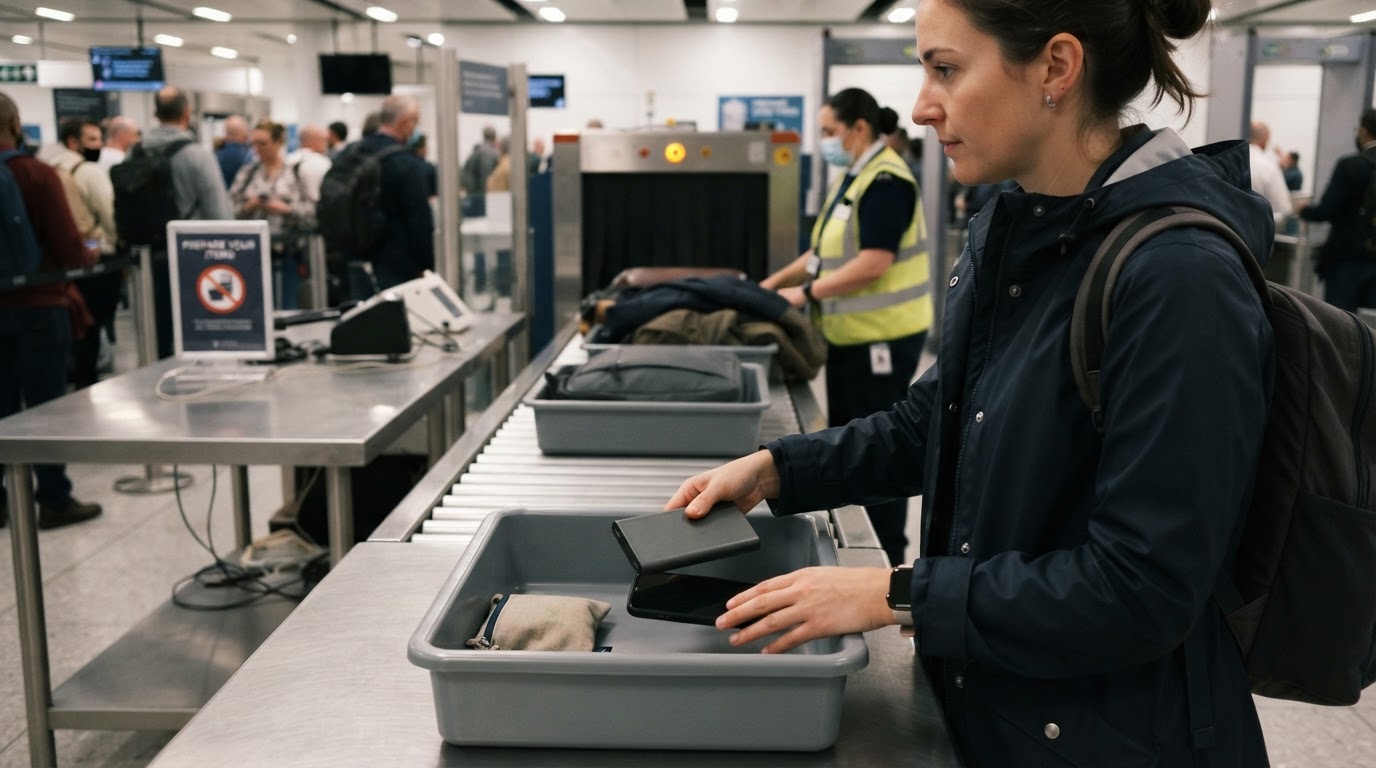
Yes, but with conditions. The UK Civil Aviation Authority tightened its rules for lithium batteries and power banks from 27 March 2026.
“Power banks must be individually protected when not in use, carried in hand luggage only, and must not be recharged on board the aircraft.” (source: UK Civil Aviation Authority, rules effective 27 March 2026)
The capacity rules work in three tiers, based on watt-hours (Wh) rather than mAh:
- Up to 100Wh: allowed in hand luggage without airline approval
- Over 100Wh and up to 160Wh: allowed only with the airline’s advance approval
- Over 160Wh: banned from passenger aircraft entirely
Since 27 March 2026, passengers are also limited to a maximum of two power banks each, and every one must be individually protected, for example in its original packaging or a separate pouch, to prevent short-circuiting against keys or coins.
A family of four flying from Gatwick to Spain is better off each packing their own 20,000mAh power bank (about 74Wh) rather than sharing one 30,000mAh unit. At 3.7V, a 30,000mAh power bank works out to roughly 111Wh, above the approval-free threshold, while four separate 20,000mAh units stay comfortably under 100Wh and match the new two-per-person limit.
Check the Wh rating printed on the power bank itself before travelling. If only mAh is shown, use Wh = (mAh × voltage) ÷ 1,000, with voltage usually printed alongside the capacity, or contact the manufacturer if it is not shown.
A power bank must never go in checked luggage, regardless of its capacity, because of the fire risk from a damaged lithium cell in the hold. It also cannot be recharged during the flight, including from a seat-back USB port.
Individual airlines can apply stricter conditions than the general UK rules, so it is worth checking the specific carrier’s policy before departure, particularly on long-haul routes outside Europe.
What to check before buying a travel power bank
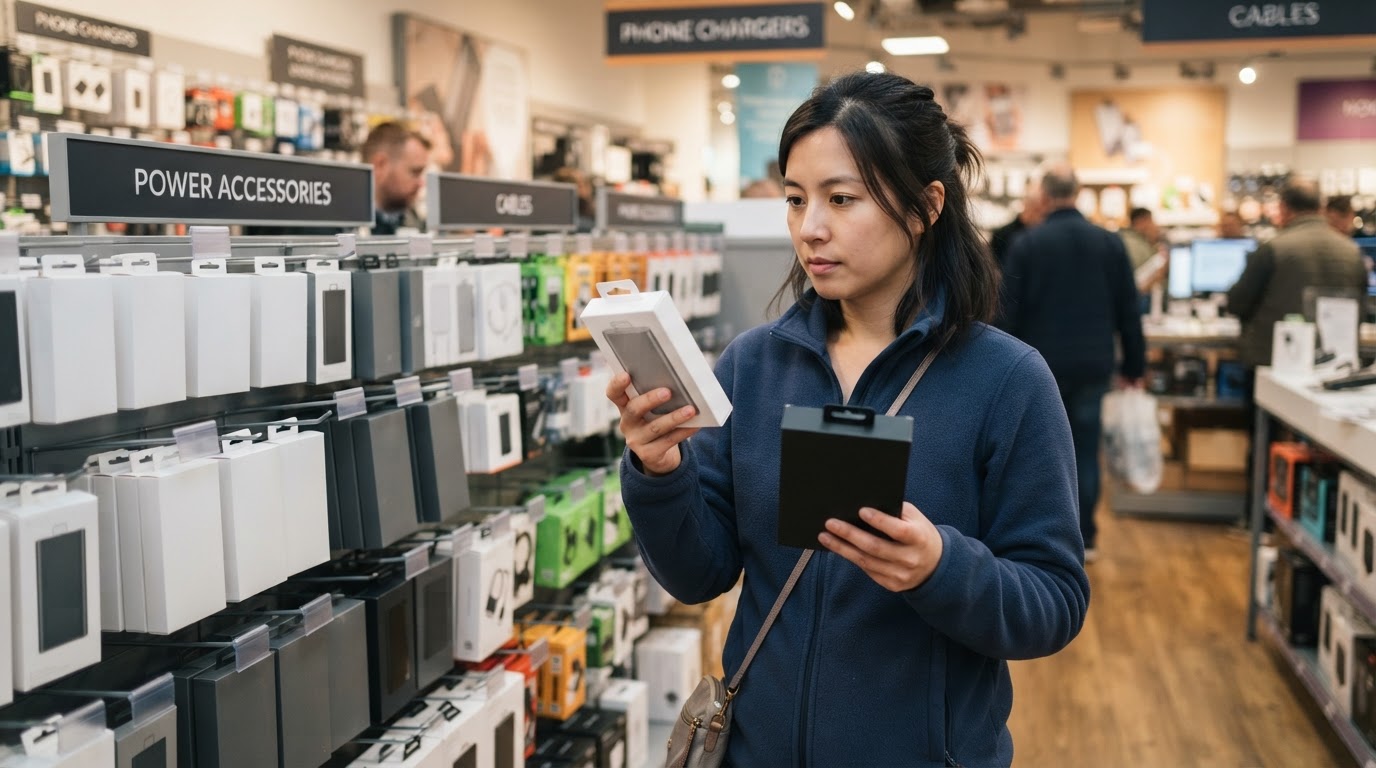
Beyond capacity, a handful of practical details separate a good travel power bank from a frustrating one.
- Output wattage: at least 65W if a laptop needs charging, far less for a phone-only trip
- Port count and type: USB-C input and output is now the standard for fast charging across devices
- Weight: a few extra grams add up across a full day of carrying it
- Pass-through charging: lets the power bank and a connected device charge at the same time
- Printed Wh rating: makes the airline check straightforward instead of a manual calculation
Watch for safety red flags before buying secondhand or from an unfamiliar seller: a case that feels swollen or warped, a battery with no visible Wh or mAh rating, or packaging with no manufacturer details. Any of these is reason enough to choose a different unit, ideally from a brand with a track record of independent testing rather than an unverified seller.
In Summary
There is no single best portable charger for every traveller. A compact 10,000mAh model covers a day trip or weekend, while 20,000-25,000mAh with higher wattage suits multi-device or laptop-heavy travel.
Whatever the capacity, check the printed Wh rating before flying: UK rules since 27 March 2026 allow up to 100Wh freely, require approval up to 160Wh, and cap most travellers at two power banks, each carried in hand luggage and individually protected.
Matching the power bank to the actual trip, rather than buying the highest capacity available, keeps both the packing list and the airport security queue simpler.
Common Questions
Which is better, a 10,000mAh or a 20,000mAh power bank?
A 10,000mAh power bank is lighter and enough for light phone use over a day or two. A 20,000mAh power bank is heavier but covers multiple devices or a longer trip without needing a recharge.
Which portable chargers are not allowed on planes?
Any power bank rated above 160Wh is banned outright from UK passenger flights. One rated between 100Wh and 160Wh needs the airline’s advance approval, and one with no visible Wh rating can be refused at security.
How many power banks can you take on a UK flight in 2026?
Since 27 March 2026, UK Civil Aviation Authority rules limit passengers to a maximum of two power banks each, both carried in hand luggage and individually protected against short-circuiting.
Can a power bank go in checked luggage?
No. Power banks must always travel in hand luggage, never in checked baggage, because of the fire risk if a lithium cell is damaged in the hold.
How do you convert mAh to Wh for a power bank?
Multiply the mAh figure by the battery’s voltage, then divide by 1,000. A 20,000mAh power bank at 3.7V works out to roughly 74Wh, well under the UK’s 100Wh approval-free limit.