
At a Glance
Renters get told to “make it feel like home” constantly, and rarely told what that actually costs or what it risks. Search “budget wall art ideas for renters UK” and you get the same handful of tips: adhesive strips, removable wallpaper, a gallery wall. What is missing almost everywhere is the maths.
This guide works through three real routes to a finished wall: DIY framing, printed art, and a ready-made framed set, along with the actual UK prices behind each one. It also covers which hanging methods hold up in a tenancy, and where the free art nobody mentions actually comes from.
Around 19% of UK households were in the private rented sector as of the year ending March 2024 (source: Office for National Statistics, 2025), so a wall that looks intentional without risking a deposit deduction is a genuinely common problem, not a niche one.
What should you check before decorating a rented wall?

Start with the tenancy agreement, not the DIY aisle. Some agreements ban nails and drilling outright, others simply require the property to be returned in its original state, wear and tear excepted.
That distinction matters: a small nail hole usually counts as wear and tear in England and Wales, but a pattern of holes across a wall or a botched removable-wallpaper job might not.
If the agreement is silent on decorating, a short message to the landlord or agent asking permission for picture hooks or a specific product is worth the ten minutes.
Written permission is also the only thing that reliably protects a deposit if a dispute ever reaches an adjudicator.
Photograph every wall before hanging anything, and again after taking it down. A dated photo is the simplest evidence if a landlord tries to charge for damage that was already there.
Where can you find wall art for free or nearly free?
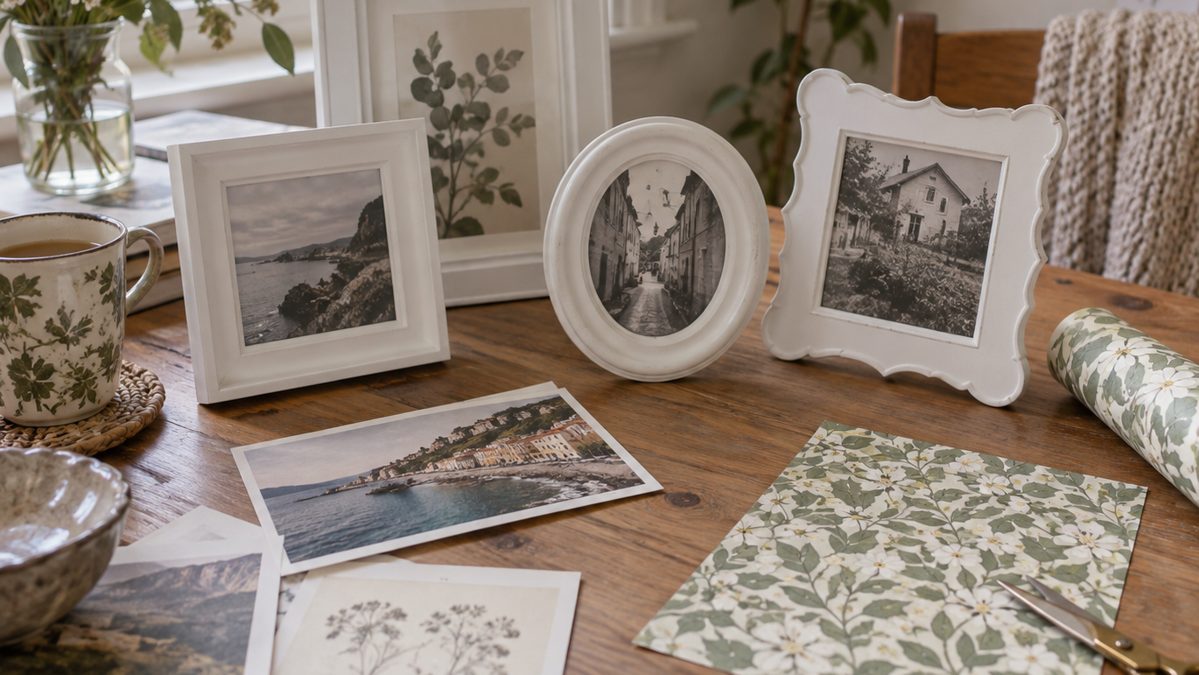
Free art is the one category almost no competing guide actually quantifies, even though it is the cheapest tier by definition.
- Open-access museum collections. The Rijksmuseum, the British Library and the Metropolitan Museum of Art all release high-resolution scans of public-domain paintings for free download, ready to print at a local shop.
- Charity shop frames. A mismatched set of frames from a charity shop, sprayed one uniform colour, reads as a deliberate collection rather than leftovers.
- Wrapping paper and postcards. A sheet of patterned wrapping paper cut to size and framed costs whatever the paper cost, often under £3, and looks close to a printed art piece from a distance.
- Old photos and ticket stubs. A grid of personal ephemera in matching frames fills a wall for the price of printing, and nobody else will have the same one.
Standardise the frame colour and finish across a free-art wall, even when the art itself is a mix of sources. Consistent frames are what make a low-cost mix look curated instead of accidental.
Which hanging methods actually hold up in a rented property?

Not every damage-free method is right for every piece. Weight, wall surface and how long it needs to stay up all change the answer.
- Adhesive picture hanging strips (Command and similar brands) hold up to 9kg for the largest (X-Large) size, with the mid-range Large size rated to 7.2kg, enough for most framed prints and small canvases, but not for a heavy mirror or a large multi-aperture frame (source: 3M/Command product specifications, 2026).
- Picture rails, common in Victorian and Edwardian conversions, take a hook and cord and can carry far more weight than any adhesive strip, with zero wall contact.
- Leaning art against a wall, on a shelf, mantelpiece or the floor, needs no fixing at all and works especially well for an oversized piece that would otherwise dominate a small room.
- A single small nail, discussed with the landlord first, is sometimes the pragmatic choice for a heavier item a strip cannot safely hold.
Adhesive strips are not damage-free on every surface. Fresh paint needs roughly two weeks to cure before a strong adhesive will remove cleanly, and textured or lightly flaking paint can lift away with the strip regardless of brand or weight rating.
How much does a budget gallery wall actually cost?

This is the number most guides skip. Below is a real cost comparison for a nine-frame gallery wall, a common size for a living room feature wall, across the three main routes.
| Method | What it involves | Real cost for 9 frames |
|---|---|---|
| DIY framing | Basic frames (IKEA RÖDALM, £5 each for 21x30cm) plus free or printed art | Around £45 to £90 |
| Printed art | Custom mounted prints from a print shop, typically £3 to £55 per piece depending on size and finish (source: My Picture UK pricing, 2026) | Around £90 to £250 |
| Ready-made kit | A curated multi-aperture set with matching frames and mounts already included | Around £70 to £150 for the full set |
The ready-made kit is not automatically the expensive option once the whole wall is counted, since it bundles matching mounts and hardware that would otherwise be bought separately.
What it removes is flexibility: the frame sizes and layout are fixed by the manufacturer, while DIY framing lets each piece be swapped or resized as the collection grows.
Gallery wall cost calculator
Estimate the total cost of a gallery wall based on how many frames you want and which route you take.
Lay the frames out on the floor first, taped-paper templates on the wall second, and only then reach for the hanging strips. Rearranging paper templates costs nothing; rearranging stuck frames does.
What works best in a small bedroom, living room or hallway?
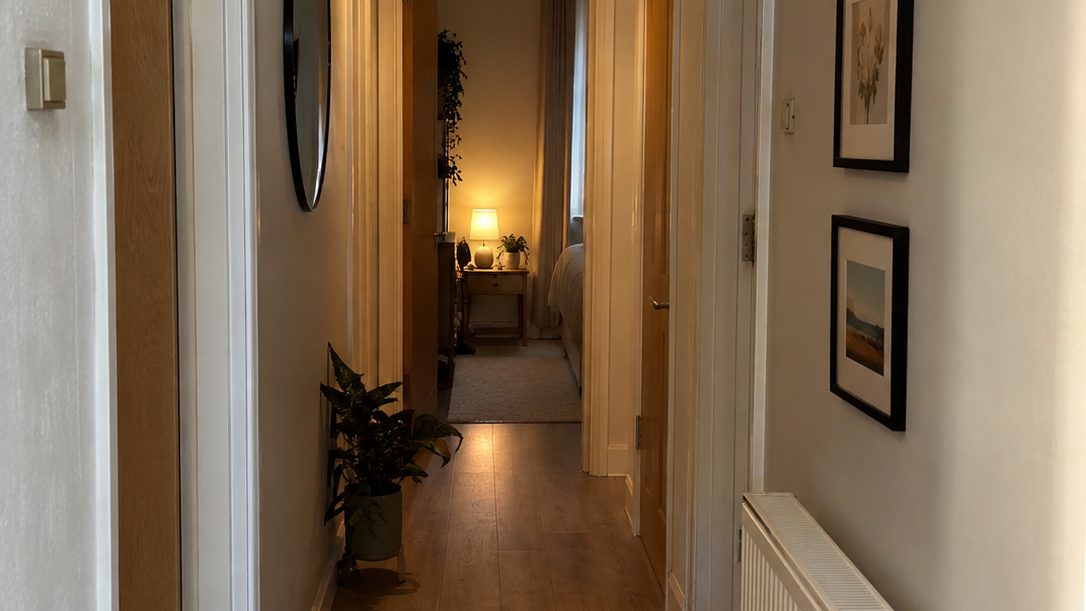
The right approach changes by room, mostly because of scale and how often the wall is actually looked at.
- Living room. Over a sofa, keep the art or gallery arrangement to roughly 60 to 70% of the sofa’s width, with 20 to 25cm of clearance above the back cushions. Anything wider looks like it is floating away from the furniture it is meant to sit above.
- Bedroom. A single oversized leaning piece behind the bed, propped rather than hung, avoids the ceiling-height debate entirely and can move with you.
- Hallway. Narrow hallways suit a tight vertical run of small frames rather than a wide gallery, since there is rarely enough viewing distance to appreciate a spread-out layout.
- Cheapest route for a large wall
- Every frame size can be changed later
- Works with genuinely free art
- Fixed layout and frame sizes
- Less room to swap pieces individually
- Can cost more per frame on a small set
For anyone who wants to see the range of finishes before committing, the RÖDALM frame series on IKEA UK is worth a look for pricing.
The ONS private rented sector statistics are worth a look too, for the scale of the renting population this kind of guide is actually written for.
In Summary
A finished-looking wall does not require the biggest budget in the room, it requires knowing which of the three routes actually suits the space and the tenancy.
DIY framing wins on price and flexibility, printed art wins on a specific look, and a ready-made kit wins on convenience for anyone who would rather not choose nine frames individually.
Whichever route gets picked, the hanging method matters as much as the art itself.
Checking the tenancy agreement, testing an adhesive strip’s weight rating against the actual frame, and photographing the wall before and after are the three habits that keep a deposit intact.
Common Questions
Can tenants decorate a rented property in the UK?
Yes, but the extent depends entirely on the tenancy agreement. Some agreements explicitly allow picture hooks and small nails, others require written permission for anything beyond removable adhesive products. Checking the agreement, or simply asking the landlord, avoids a dispute over the deposit later.
What is the 2/3 rule for wall art?
It is a sizing guideline: a piece of art or a gallery arrangement above a sofa or console table should span roughly two-thirds of that furniture’s width. Narrower and it looks disconnected from the furniture, wider and it can overwhelm the wall.
What are the most common gallery wall mistakes?
Hanging pieces too high, leaving inconsistent gaps between frames, and mixing too many frame finishes without any repeated colour or material to tie them together. A paper template taped to the wall before drilling or sticking anything avoids most of these.
How much weight can picture hanging strips actually hold?
The largest Command-style strips (X-Large) are rated to hold up to 9kg when applied correctly to a clean, cured painted surface, with the mid-range Large size rated to 7.2kg. Anything heavier, such as a large mirror or a substantial multi-aperture frame, needs a picture rail, a hook into a stud, or a landlord’s written go-ahead for a proper fixing.
Are gallery walls still in style?
Yes, though the current version tends to be more restrained than the maximalist gallery walls of a few years ago, favouring a tighter colour palette and fewer, better-chosen pieces over covering the entire wall.
<\/details>\n<\/div>\n\n