
At a Glance
Choosing the best power bank UK shoppers will actually carry is harder than it looks, because the number printed on the box overstates what reaches your phone.
A 10,000mAh label does not mean 10,000mAh of charge for your device.
This guide turns the label into real phone charges, then matches the size to a typical day rather than a holiday.
It covers pocket-sized models for commuting, MagSafe-style magnetic packs and the wattage a laptop needs.
What does a power bank’s rated capacity really deliver?
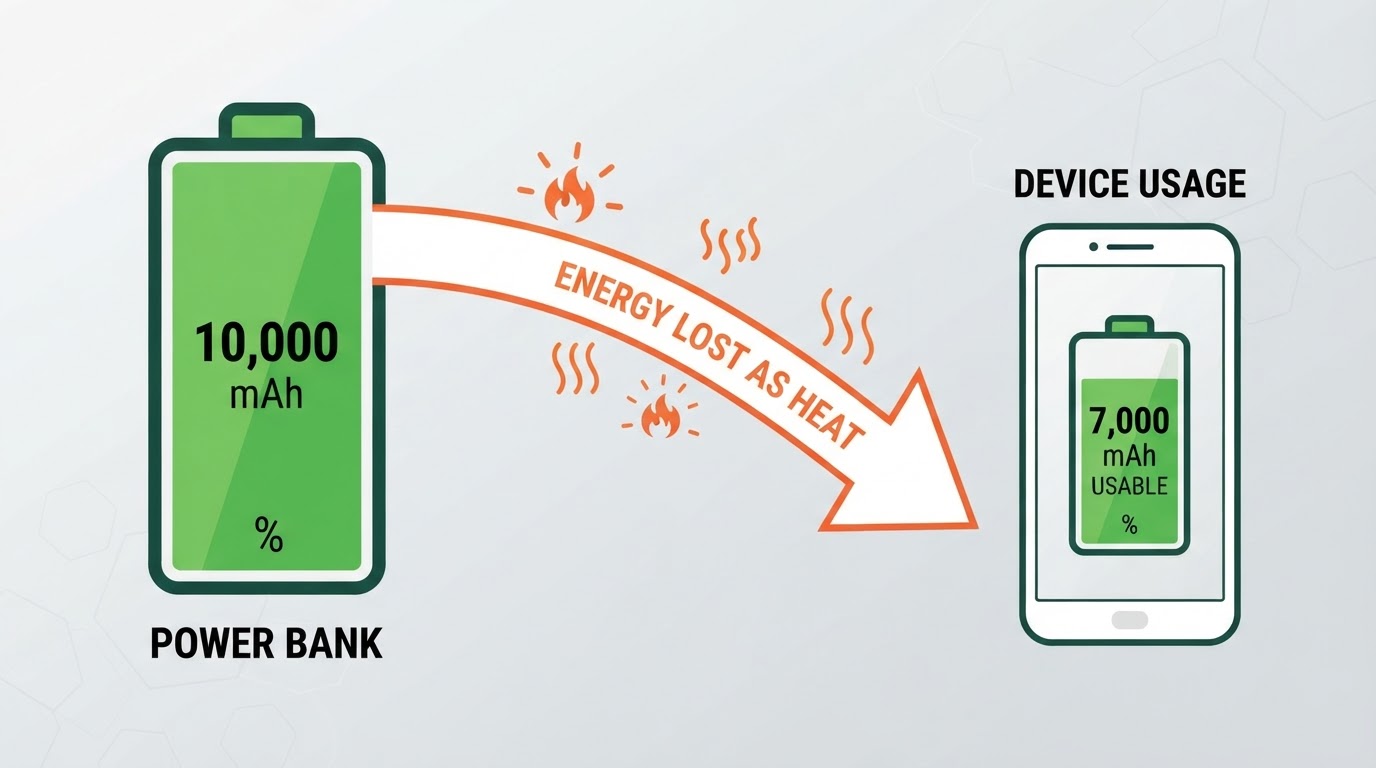
The mAh figure on the box is measured at the battery cell’s own voltage, not at the 5V a USB port delivers.
Converting between the two, and losing some energy as heat, means the usable capacity is lower than the label.
One review round-up puts quality power banks at roughly 65% to 75% of rated capacity reaching the device (The Great Reviewer, 1 October 2026).
Which? makes the same point, noting that some banks are “much less efficient as they lose lots of energy through heat” (Which?, last checked June 2026).
Its size bands use a 4,000mAh test phone: up to 7,500mAh usually gives one charge, 7,500 to 14,999mAh about two, and 15,000mAh or more four or more.
The 65% to 75% range is a typical spread, not a promise. A cheap, poorly built pack can fall below it, so a larger label does not guarantee more charges.
Typical case: a 10,000mAh pack at 70% efficiency gives about 7,000mAh of usable charge.
A phone with a 4,500mAh battery therefore gets roughly 1.5 full charges, not the two a quick glance at the label suggests.
Estimate your real phone charges
Enter the capacity printed on a power bank and pick your phone size and the pack’s build quality to see an estimate of full charges. The efficiency options follow the 65% to 75% range above, so treat the result as a guide.
Power bank rated capacity (mAh)
Your phone battery
Power bank build quality
Which capacity suits an everyday commute?

For calls, music and maps on a commute, a 10,000mAh power bank is usually enough for a day plus a margin.
Several brand guides agree it is the daily-carry size for phones and earbuds, with 20,000mAh better for longer trips or sharing (Anker, accessed October 2026).
The bigger pack is heavier and thicker, and it takes longer to recharge itself.
A 20,000mAh charger left at home because it feels heavy protects nothing.
- Fits a coat pocket or small bag
- About one to two phone charges
- Recharges faster
- Not enough for several days away
- Struggles with a tablet and a phone together
Typical case: someone who commutes 90 minutes each way and streams music rarely drains a phone below 20% by the evening.
For them, one 10,000mAh pack covers a full week of top-ups with a weekend recharge.
Heavier users who also run a tablet should look at a larger pack, as covered in our budget tablet guide.
Which power banks are worth a look at each budget?
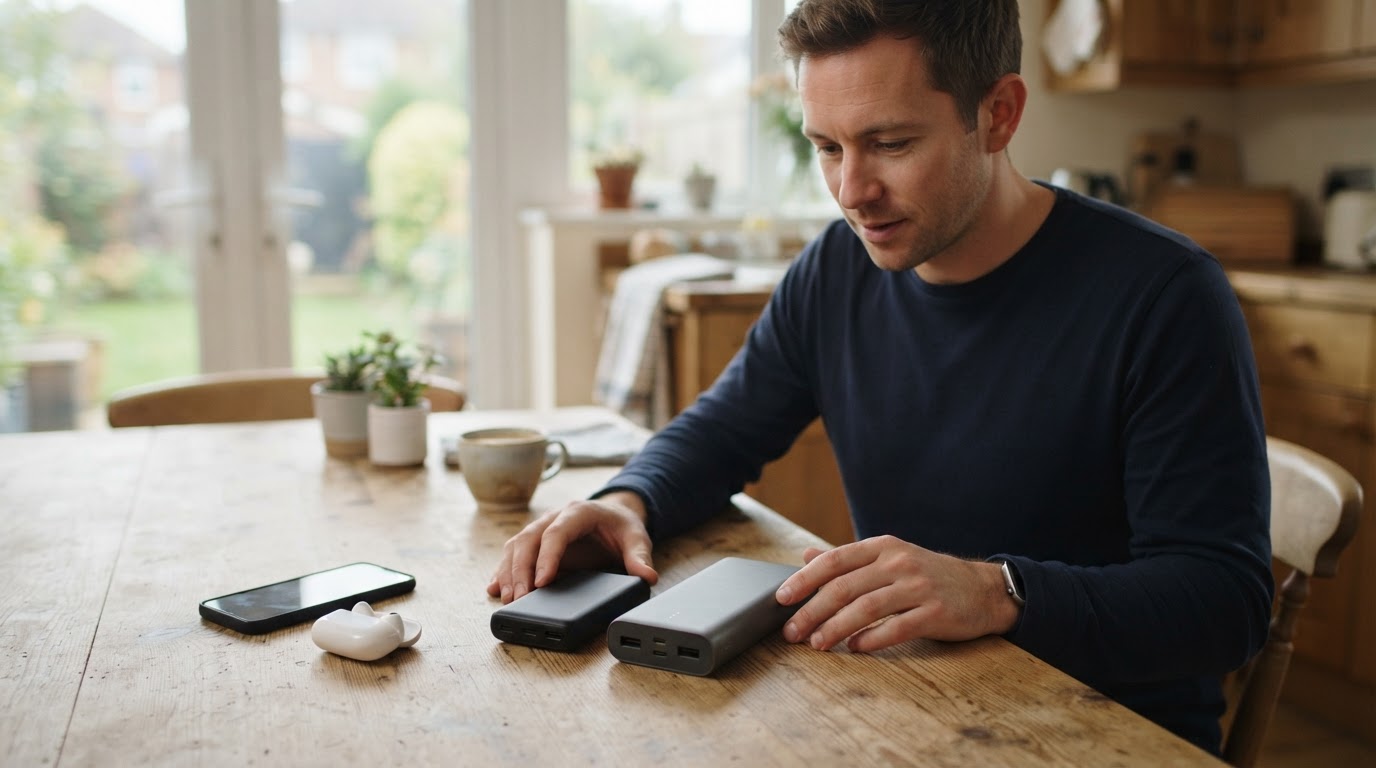
The table below uses models tested and priced by Expert Reviews (10 July 2026), so prices are a snapshot and will have moved.
| Model | Capacity | Output | Price | Suits |
|---|---|---|---|---|
| Cuktech 10 Mini | 10,000mAh | 55W USB-C | £25 | Cheap daily carry |
| Iniu SnapGo Air | 10,000mAh | 45W USB-C | £55 | Magnetic wireless |
| Anker Laptop Power Bank (A1695) | 25,000mAh | 165W | £75 | Laptop and phone |
| UGreen Nexode PB771 | 20,000mAh | 145W combined | £100 | Several devices at once |
The value pick here is the £25 Cuktech, which the same review names the best budget model.
The step up to a 20,000mAh or 25,000mAh pack costs more mainly for wattage, not for extra phone charges.
Check the current price at a UK retailer before buying, as these figures date from July 2026.
Do you need MagSafe charging or laptop output?

A magnetic power bank snaps onto the back of a compatible iPhone and charges without a cable.
Anker says its slim 10,000mAh MagGo model takes an iPhone 15 Pro from 0 to 50% in about 41 minutes over Qi2 (Anker UK, 28 February 2026), which is a brand claim rather than an independent test.
Wireless charging is slower and loses more energy than a cable, so a magnetic pack suits convenience rather than speed.
Wireless top-ups waste more energy as heat than a USB-C cable, so a magnetic pack gives fewer full charges than the same capacity used wired.
Laptops are a different job, where wattage matters more than capacity.
Which? warns that a bank rated below the laptop’s power requirement may not deliver a steady supply and can strain the battery over time (Which?, last checked June 2026).
Typical case: a 25,000mAh pack stores about 92.5Wh at 3.7V, and at 70% efficiency around 65Wh is usable.
For a hypothetical laptop with a 50Wh battery, that is roughly 1.3 full charges.
Students weighing a laptop and charger together can compare it with our budget laptop guide.
What should you check on the spec sheet before buying?

A short checklist beats a long product comparison when the labels are this misleading:
- Work out usable charge: rated mAh multiplied by about 0.7.
- Match the USB-C output to the device, from about 20W for a phone to the laptop’s own requirement.
- Check weight and thickness against where it will be carried.
- Confirm it supports your phone’s wireless standard if you want magnetic charging.
- Look for independent test results rather than only the brand’s own claims.
Airline rules depend on watt-hours rather than mAh, and the current UK position is set out in our travel chargers guide.
For testing methods in more depth, Expert Reviews and Which? both publish their approach.
In Summary
The label on a power bank is a ceiling, not a forecast, and about 70% of it is a safer planning figure.
For most commuters, a 10,000mAh pack at £25 to £55 covers the day, while laptops need a high-wattage USB-C pack.
Run your own numbers in the calculator above, then check the current price before you buy.
Common Questions
What is the best power bank brand in the UK?
No single brand wins every category. The Expert Reviews list above spans Anker, Cuktech, UGreen and Iniu, so judge a model on tested efficiency, output wattage and price rather than the name alone.
How many days can a 20,000mAh power bank last?
At 70% efficiency it gives about 14,000mAh of usable charge. For a 4,000mAh phone that is around 3.5 full charges, so roughly three days if you recharge the phone once a day.