
At a Glance
Searching for the best refrigerator in the UK mostly leads to fridge-freezer guides, because that is what most British kitchens hold.
Most of those guides rank models by price and rating, then stop before the two questions that decide the purchase.
Will it physically fit your kitchen, and what will it cost to keep running for the next decade?
This guide starts there, then matches each size to a kind of household, with example models whose specifications come from a published October 2026 buying guide.
What does the best refrigerator mean in a UK kitchen?
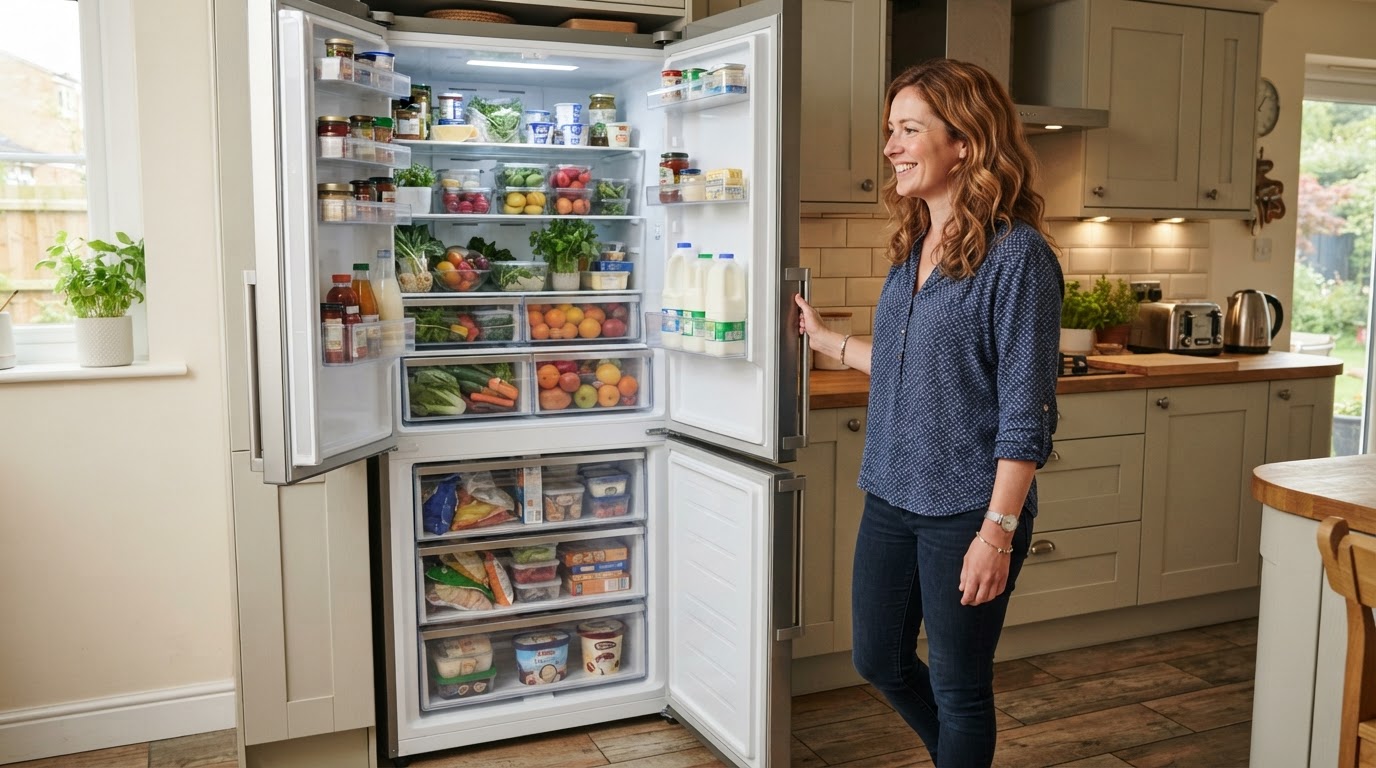
In British shops, a refrigerator with a freezer drawer or compartment is called a fridge-freezer.
A fridge on its own is usually a tall larder fridge or an under-counter unit, and it suits kitchens that already have a separate freezer.
Fridge-to-freezer ratios matter too. Examples quoted by Which?, 13 October 2026 are 60/40, 70/30 and 80/20, so a 70/30 split gives more fresh space and less frozen space.
People who shop for fresh food several times a week tend to want the larger fridge share.
People who batch-cook and freeze meals lean towards 50/50 or 60/40.
The same label scale applies to every type. Since the A to G label replaced the older A+++ scale, very few models reach A, and most sit between C and E, according to the NRLA, accessed October 2026. A D or E rating can still be a sound choice.
Which width fits a UK kitchen?
Width settles the choice before any feature does. The Joybuy buying guide, October 2026 puts standard and slimline models at 55-60cm wide, large-capacity models at 70-80cm, and American-style models at 90cm or more.
Built-in models are a separate case: according to Which?, 13 October 2026, they usually slot into a standard 60cm-wide cupboard and are usually 55cm deep, with heights from about 100cm to 200cm.
| Type | Typical width | Best suited to |
|---|---|---|
| Slimline or standard freestanding | 55-60cm | Most UK kitchens with a standard appliance gap |
| Integrated (built-in) | About 60cm cupboard | Fitted kitchens where the fridge hides behind a door |
| Large or extra-wide | 70-80cm | Bigger households with a wider gap or open space |
| American-style | 90cm or more | Large kitchens, often with a water or ice dispenser |
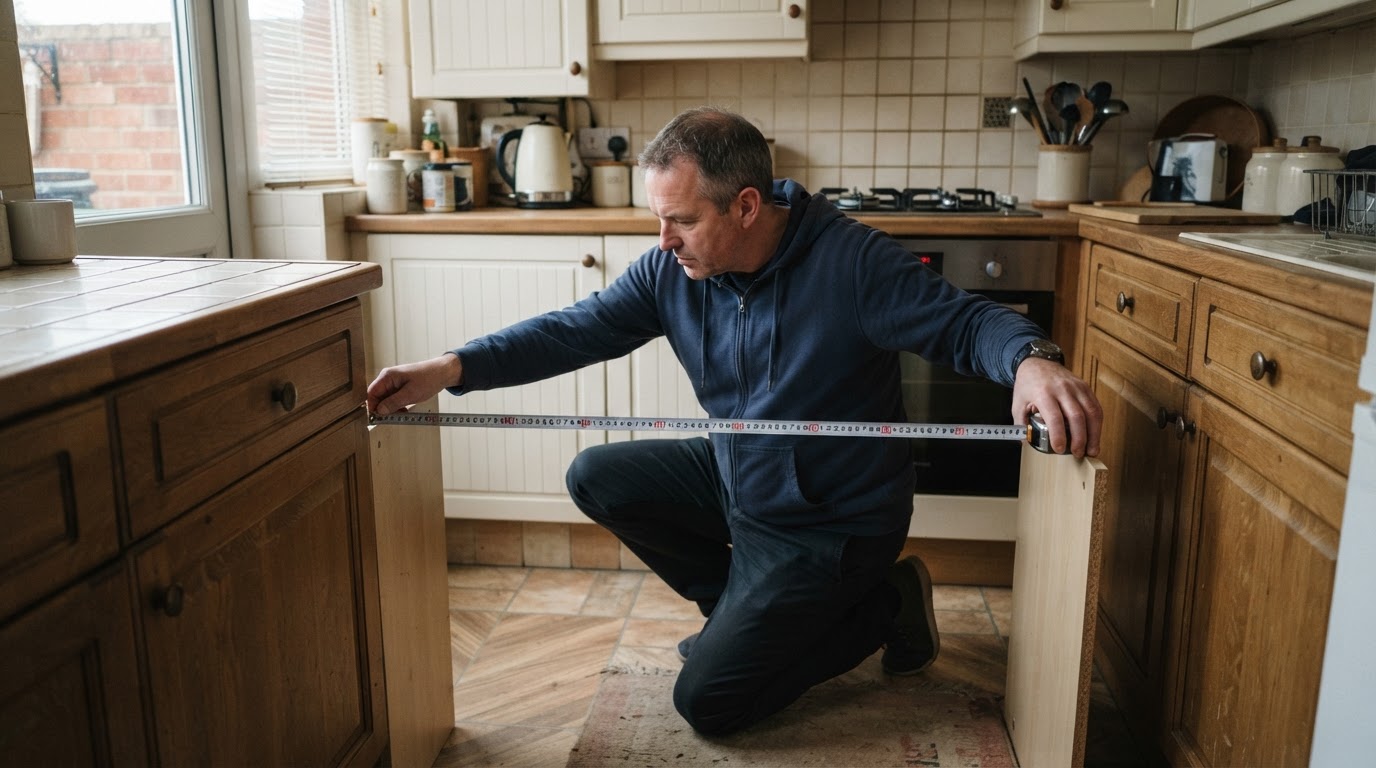
Measure the gap at the top, middle and bottom, then measure the height and depth. Walls are rarely perfectly straight, so use the smallest measurement.
Also measure the route into the house. A wide model that fits the gap can still fail at a narrow hallway, a tight turn or a staircase.
Door swing is the other trap. In a small kitchen, check that the fridge door can open fully without hitting a wall, an oven door or an island.
A couple in a flat with a 60cm appliance gap has two real options: a standard 55-60cm model or a slimline one. An American-style unit is not an option, however large the shop display looks. (Illustrative example, not a customer story.)
How much does a fridge-freezer cost to run per year?

For 1 October to 31 December 2026, the average electricity rate under the price cap is 26.32p per kWh, with a daily standing charge of 54.83p (Ofgem, price cap for 1 October to 31 December 2026).
Household Money Saving, 1 March 2026 reports that most modern fridge-freezers use between 100 kWh and 300 kWh a year, and American-style models typically use 300-450 kWh.
Multiplying those figures by the current rate gives a clear picture of what the energy label means in pounds.
| Annual use (kWh) | Cost per year at 26.32p | Cost over 10 years |
|---|---|---|
| 100 | £26.32 | £263.20 |
| 150 | £39.48 | £394.80 |
| 200 | £52.64 | £526.40 |
| 300 | £78.96 | £789.60 |
| 450 | £118.44 | £1,184.40 |
The ten-year column assumes today’s rate never moves, which it will. It still shows the scale of the difference.
Between a 100 kWh model and a 300 kWh model, the gap is £52.64 a year at this rate, or £526.40 across ten years.
The cost comes from the kWh number on the label, not the energy letter. Two models with the same letter can still differ in annual use, and the standing charge is a fixed daily cost that a fridge does not change.
Run the numbers for your own fridge-freezer
This calculator turns the kWh figure from any energy label into a yearly cost and a total cost of ownership, using the price cap rate as the default.
Typical lifespan matters here. The Joybuy buying guide, October 2026 says a well-maintained fridge-freezer should last roughly 10 to 15 years, so a ten-year view is a realistic comparison.
Smart plugs with energy monitoring can also show what your current appliance really draws.
Which fridge-freezer suits which household?
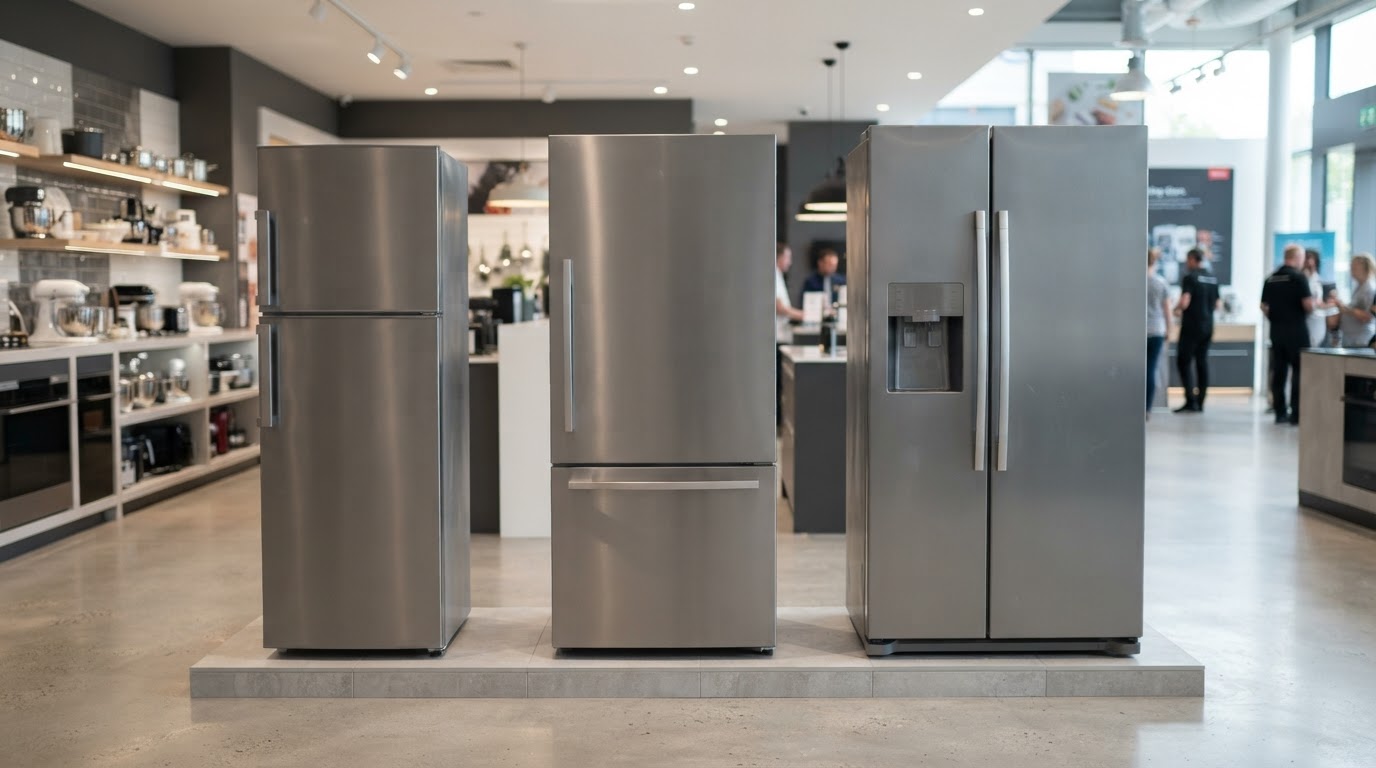
Rather than crowning one winner, it makes more sense to match a size to a household. The three example models below come from the Joybuy buying guide, October 2026, and their figures are manufacturer specifications, not independent lab results.
| Example model | Width | Capacity | Noise | Energy class |
|---|---|---|---|---|
| Midea MDRB379FGD30 (Total No Frost) | 54.7cm | 273 litres | 38 dB | D |
| Samsung RB53DG703CS9EU (extra-wide) | 75.9cm | 538 litres | 35 dB | C |
| LG GSGV81EPLD (American-style, smart) | Not stated (class: 90cm or more) | 635 litres | 35 dB | Not stated |
The Midea is 180cm tall with a 60/40 split, so it suits a standard gap and a small household.
The Samsung gives much more capacity at 75.9cm, but it only works if the kitchen has a wider space for it.
The LG is the American-style example, with a 4-litre internal water tank. It needs a large kitchen, and American-style models typically use more electricity, around 300-450 kWh a year.
Prices change weekly and are not listed here on purpose. Check the current price, the kWh figure and the exact dimensions on the retailer’s specification sheet before ordering.
- More room for big shops and batch cooking
- Quieter figures on the two larger examples above (35 dB)
- Features such as a water dispenser
- Needs a wider gap and wider doorways
- Higher kWh range (typically 300-450 for American-style)
- Higher purchase price in most cases
What should you check before you buy?

Run through this checklist in order, since the first items rule options out before the later ones matter.
- Measure the gap, the height, the depth and the route into the house.
- Check that the door opens fully, and whether the hinges can be reversed.
- Choose a fridge-to-freezer split that matches how you shop.
- Read the kWh figure per year, then price it at your unit rate.
- Look at the noise figure. The Joybuy guide treats 40 dB or below as quiet, which matters in an open-plan room.
- Decide whether frost-free operation is worth it to you.
- Ask about delivery, installation and old appliance collection when you order.
Photograph the energy label and the specification sheet before you leave the shop or close the browser tab. Models with near-identical names often have different widths.
Reliability and ownership deserve a final look too: warranty length, how easy the shelves are to clean, and whether the retailer handles repairs.
Smart screens and cameras are optional extras, and they add cost without changing how well the fridge cools.
In Summary
The best refrigerator for a UK kitchen is the one that fits the gap, then the one that costs least to run over a decade, then the one with the layout you will use.
At the current price cap rate, a 100 kWh model and a 300 kWh model differ by £52.64 a year, which is why the label’s kWh figure is worth reading.
Measure twice, price the electricity, and treat the ranked lists as a source of ideas rather than a verdict.
Common Questions
What temperature should the fridge compartment be set to?
The Food Standards Agency, accessed October 2026 advises keeping a household fridge at 5°C or below. Dials do not always show the true temperature, so a cheap fridge thermometer is a more reliable check than the dial setting.
What happens to the old fridge-freezer when the new one arrives?
Retailers are generally expected to take back an old appliance of the same type when delivering a new one. Collection usually has to be arranged when the order is placed, not on the doorstep. If the retailer does not offer it, local councils list recycling routes, for example Central Bedfordshire Council, accessed October 2026.
Is a frost-free fridge-freezer worth choosing?
A frost-free (no frost) freezer compartment removes the need to defrost by hand, which is the main practical gain. It usually comes with a fan, so check the noise figure on the label before buying.
Do ice dispensers and smart screens lower the electricity bill?
No. These features add convenience, and sometimes cost and parts that can go wrong, but they do not improve basic cooling. For running costs, the kWh figure on the energy label is the number to compare.