
At a Glance
The best badminton racket for beginners in the UK is rarely the most advanced one on the shelf.
Pro-level frames are stiff, heavy at the head and demanding on the wrist.
A first racket should forgive off-centre hits, swing easily and survive a few clumsy clashes with the floor.
This guide explains the four specs that matter, sorts entry-level options by budget, and flags the stringing trap that catches many first-time buyers.
What makes a badminton racket beginner-friendly?
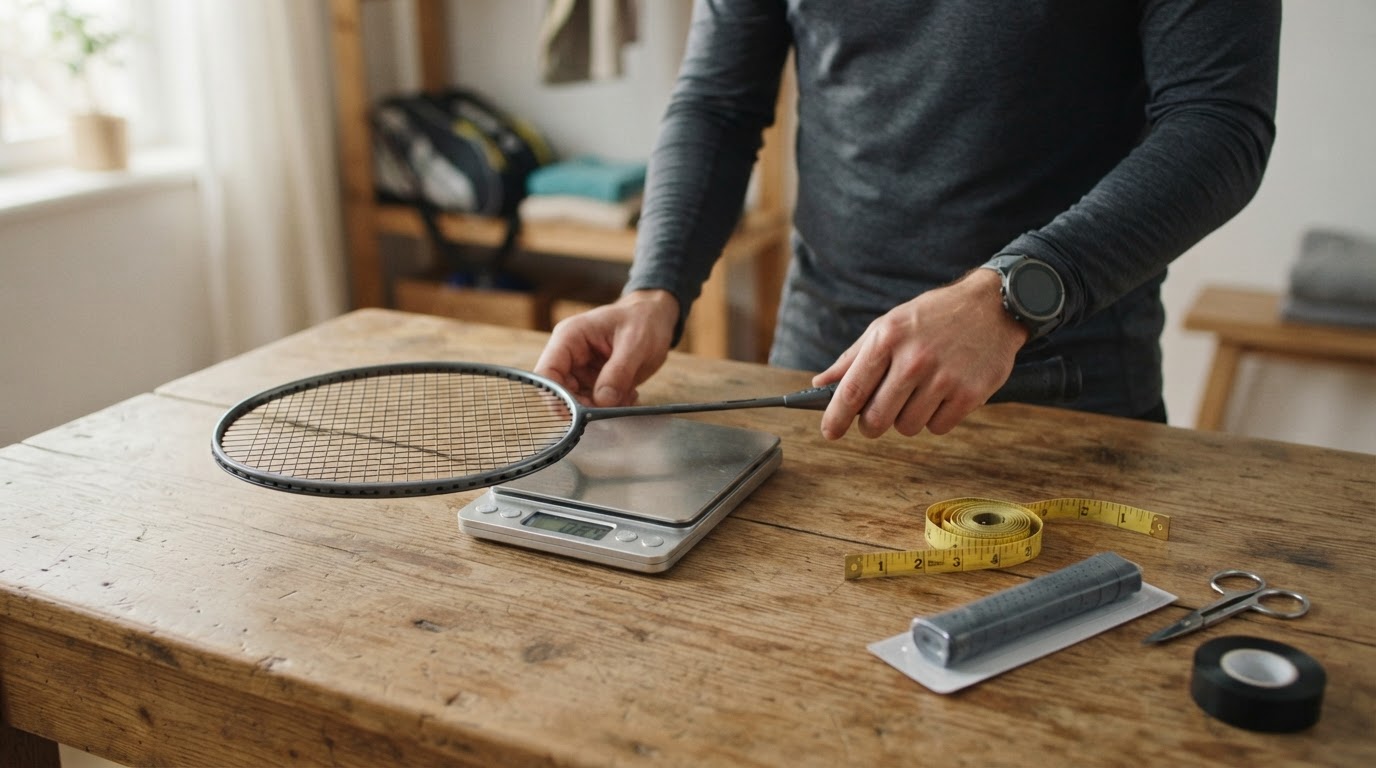
Four specs decide how a racket feels in the first few weeks: weight, balance, shaft flex and grip size.
Weight is shown as a “U” number, and a higher number means a lighter racket.
Yonex lists 5U at an average of 78 g, 4U at 83 g and 3U at 88 g (Yonex UK product specifications, accessed October 2026).
| Weight band | Average weight | Typical player |
|---|---|---|
| 5U | about 78 g | Beginners, casual players, anyone protecting a wrist or elbow |
| 4U | about 83 g | Regular club players and confident doubles players |
| 3U | about 88 g | Strong singles and back-court attackers |
Central Sports recommends a 5U racket with an even balance and a medium-flex shaft for beginners, and suggests a string tension of 22 to 24 lb if you have it strung to order (Central Sports UK guide, 2026, accessed October 2026).
It also warns against pro-stiffness frames, which it says can cause shoulder and elbow strain for new players.
Advice on weight is not unanimous. Some guides place regular adult players in 4U from the start, so 5U is the safer default for a true beginner, not a rule for everyone.
Grip size follows a similar logic, with a higher G number meaning a thinner handle.
A G5 grip, which is thinner than G4, is the common entry size.
Typical case (illustrative): an adult who plays one casual evening a week and has had a sore elbow before is a textbook 5U buyer, because a lighter racket asks less of the joint on every swing.
Which badminton racket types suit a beginner at each budget?
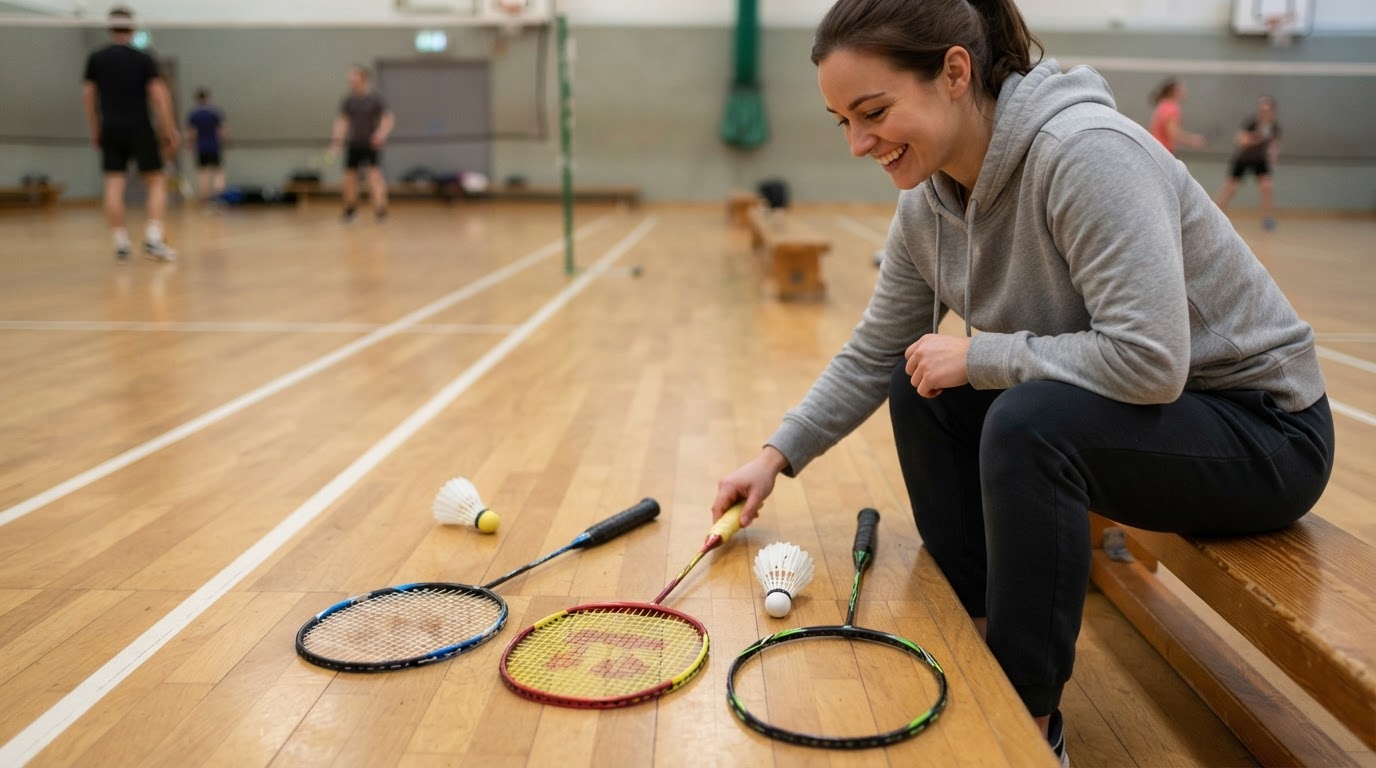
Entry-level rackets fall into three practical tiers, and each one suits a different kind of player.
MoreSports’ 2026 UK guide to beginner rackets lists eight models between about £15 and £45, all pre-strung (MoreSports, 2026, accessed October 2026).
Prices move often, so treat these as ranges and check the live price before buying.
| Budget tier | What to expect | Example from the guides |
|---|---|---|
| Under £30 | Pre-strung, durable, simple frame, low maximum tension | Yonex Muscle Power 2 (£15 to £25), Carlton Aeroblade 300 (£20 to £30) |
| £30 to £60 | Graphite frame, a more refined feel, room to improve | Yonex Astrox 01 Feel and Nanoflare 001 Feel (£30 to £45), Victor Thruster K 15 Light (£25 to £40) |
| £60 and above | Better materials and balance, worth it once you play weekly | Yonex Astrox 01 Ability, described by Central Sports as the best-value Yonex frame under £60 |
The cheapest tier is a fair way to find out whether the sport sticks.
The Yonex Muscle Power 2 has an aluminium frame and steel shaft, and a retailer listing of Yonex’s specification gives a recommended tension of only 16 to 20 lb (Joy Badminton listing, accessed October 2026).
- Very low cost for a first purchase
- Tough enough to survive mishits and floor knocks
- Comes strung, so nothing else to pay for
- Heavier feel and less control than graphite
- Low maximum tension, so it cannot be restrung tight
- Most regular players outgrow it within months
Astrox or Nanoflare: which suits a beginner better?
Both are Yonex ranges, and they differ mainly in balance.
Nanoflare rackets are generally head-light, which suits speed, quick defence, flat drives and net play.
Astrox rackets are typically head-heavy, which helps generate power from the back of the court, although the entry-level Astrox 01 Ability is closer to even balance.
For a first racket, the entry versions of either range work, as long as the weight is 5U and the shaft is not stiff.
A beginner who mostly plays doubles often finds a head-light frame easier, whereas someone who loves smashing may prefer a slightly head-heavy one.
If the choice is unclear, an even-balance entry racket sits safely in the middle. Our family game night guide shows the same logic: pick for the people actually playing, not for the box.
Pre-strung or frame only: what trips beginners up?

Many Yonex listings sell the same racket as a “frame” or as a “pre-strung” version.
A frame arrives with no strings and needs stringing at a shop, which adds a cost and a decision about tension.
Each racket carries a maximum tension, and stringing above it can crack the frame and may void the warranty.
The range is wide: the Muscle Power 2 is quoted at 16 to 20 lb, while the Astrox 01 Ability is listed with a maximum of 28 lb (retailer listings of Yonex specifications, accessed October 2026).
That gap is the gap most beginners miss. A tension that suits one frame can damage another.
A higher tension is not better for a beginner. Tighter strings generally shrink the sweet spot, so off-centre hits can feel harsher and travel less.
Pre-strung rackets avoid the question altogether, and that is why they are the sensible default for a first purchase.
Complete sets are another route. Joybuy UK’s guide to two-player sets advises looking for iron-aluminium frames that come pre-strung, ideally with a carry bag (Joybuy, October 2026).
A set is convenient for a one-off garden or hall game, but graphite is the better choice for anyone planning to play weekly.
Ask the seller for the maximum tension in writing before buying a frame-only racket. A shop that strings rackets will know the figure straight away.
Which racket spec should you start with?
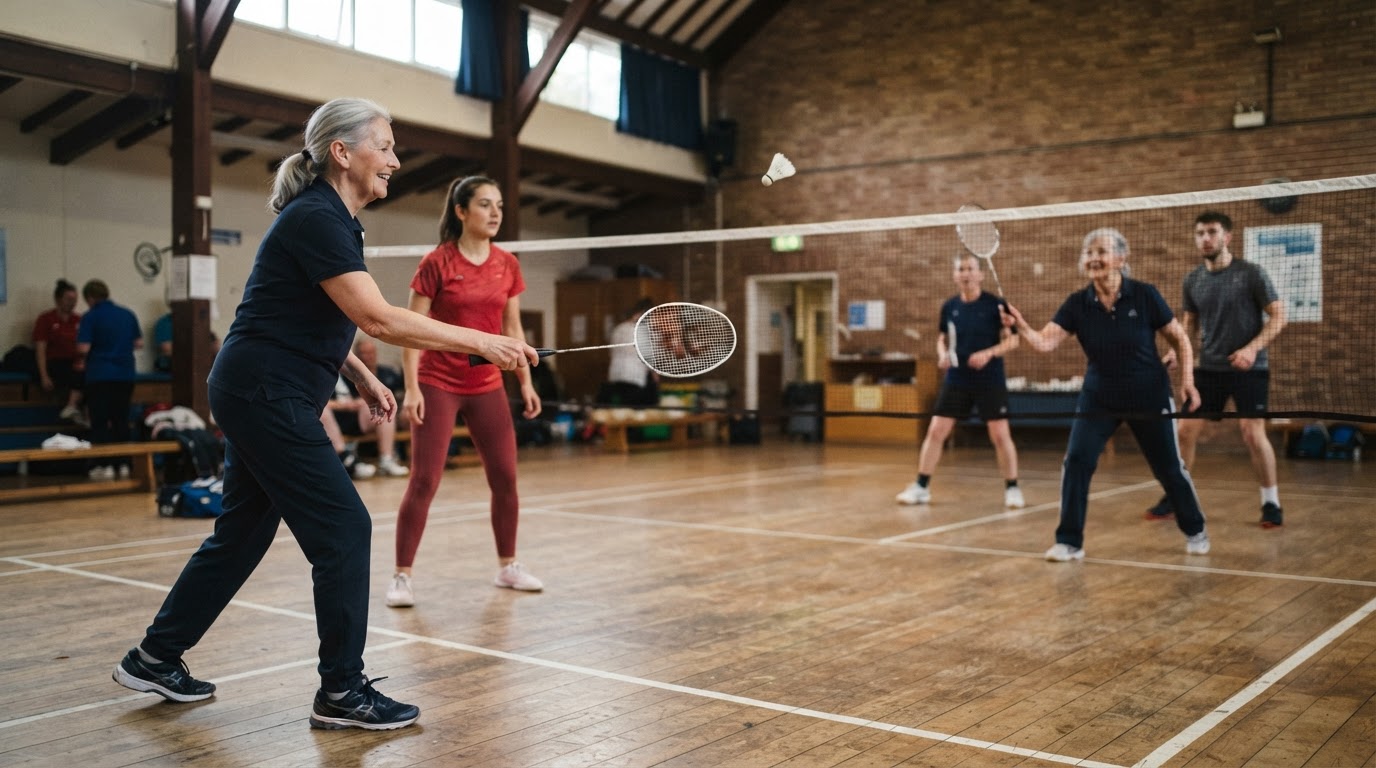
Typical case (illustrative): a parent who joins a Sunday doubles session and wants a racket that is easy on the wrist has different needs from a keen newcomer planning to join a club.
The finder below turns those answers into a starting specification.
Beginner racket spec finder
This tool maps how often you play, your usual game, joint comfort and budget to a weight band, balance and tension range. The output is a starting point drawn from the guidance above, not a guarantee.
Before paying, run through this short checklist:
- Weight band is 5U, or 4U if you are already strong and play weekly.
- The balance is even or head-light, and the shaft is flexible or medium.
- The racket is pre-strung, or the seller confirms the stringing tension.
- A cover is included, and the grip size is G5 or comfortable in your hand.
- The return policy covers a racket you have only tried indoors.
The same checklist logic applies to other first-time kit, as in our beginner running gear checklist and the beginner cycling gear checklist.
In Summary
A first badminton racket should be light, forgiving and pre-strung, with a weight of 5U for most newcomers.
Budget rackets are fine to start with, but check the maximum tension before any restringing.
Once you play weekly, a graphite racket in the £30 to £60 range is the usual next step.
Common Questions
Is Li-Ning or Yonex better for a beginner?
Neither brand is better by default. Both make light, pre-strung entry rackets, so the weight, balance and flex of the specific model matter more than the logo. Li-Ning’s Axforce 10 is described by MoreSports as head-heavy, which suits attacking play, while many Yonex entry models are even or head-light.
Should a beginner get a 3U or 4U racket?
Most beginners are better off in 5U. A 4U racket suits strong, regular players, and 3U is built for back-court attackers who can control the extra weight.
When should a beginner upgrade a first racket?
An upgrade makes sense once you play weekly and notice the racket limiting you, for example when an aluminium frame cannot take a higher tension. Until then, better technique does more than a more expensive frame.
Is a racket set with shuttlecocks worth buying?
A set is fine for occasional garden or hall games because it includes a bag and shuttlecocks. For regular play, a single graphite racket gives better control.