At a Glance
A marble dining table can mean three quite different things on a UK listing: a solid stone slab, a thin stone layer on a board, or a marble-look finish with no marble in it.
That choice sets the price, the weight and how the top copes with a glass of red wine.
This article compares real marble with marble effect on the points that only show up after delivery, then adds a calculator for table and room size.
What does marble dining table mean on a UK listing?

Retailers use the word loosely, and tables described as marble, marble effect or sintered stone often sit side by side in the same category.
Castlery lists its Kelsey dining table with a Carrara marble top at £1,199 in the 160 cm size, and describes its marble dining tables as having solid wood bases (Castlery UK, accessed October 2026).
Fishpools lists its Cloud round table, 120 cm across, at £399 (was £579). The page describes a “smooth solid stone top” with a marble-effect finish, which is not the same thing as solid marble (Fishpools, accessed October 2026).
Weight does not settle the question either. John Lewis listed the Gallery Direct Wren as marble effect, 180 cm long and 100.8 kg, so a heavy table is not proof of real stone (John Lewis, accessed October 2026, no longer available online).
| Top type | What it is | UK example in this article | Main trade-off |
|---|---|---|---|
| Real marble | Natural stone slab, typically 20 to 30 mm thick | Castlery Kelsey, £1,199 | Porous, etches, heavy |
| Marble effect | A stone or engineered top finished to look like marble | Fishpools Cloud round, £399 | Material varies, so the data sheet matters |
| Sintered stone | Mineral slab pressed and fired at very high temperature | Sold with marble-look veining | Harder, but no natural variation in the veining |
How do real marble and marble effect compare in daily use?
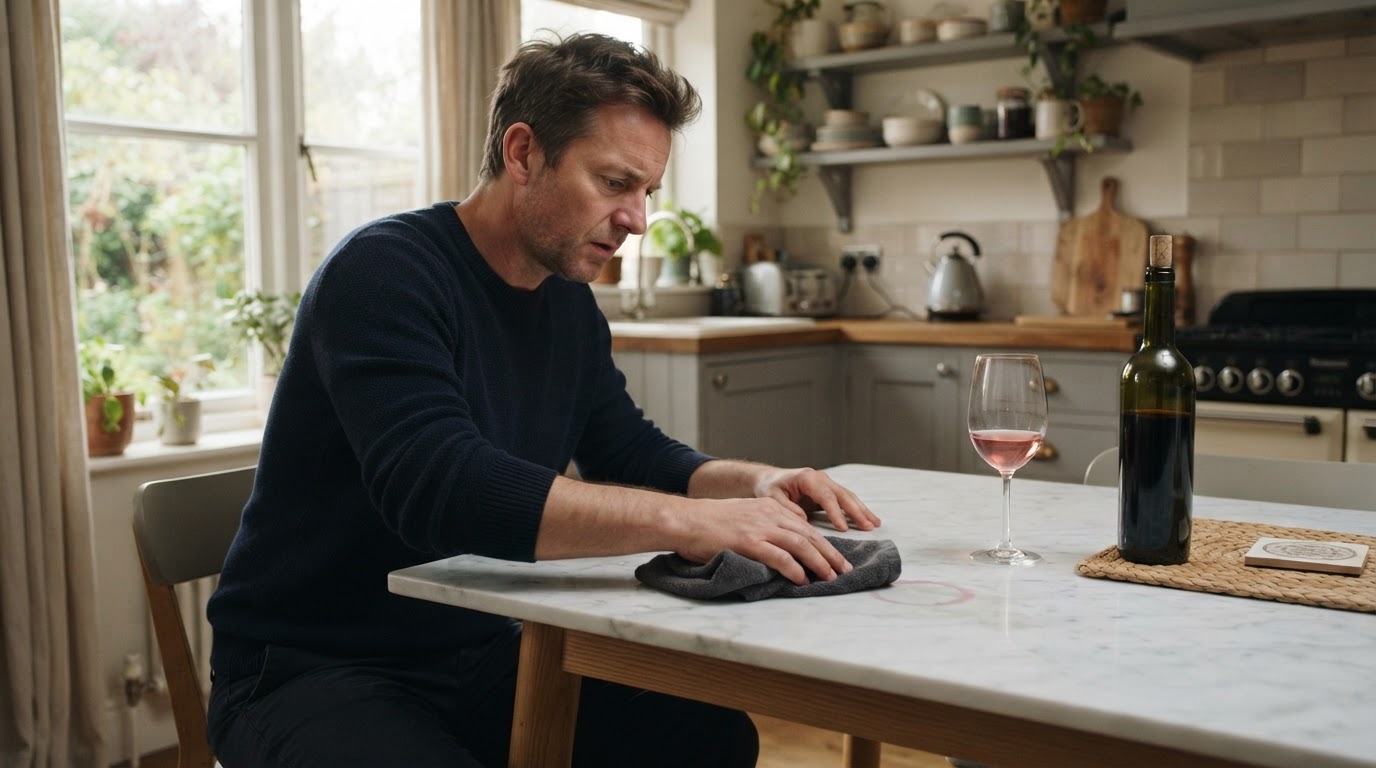
Real marble is a porous, fairly soft stone. One US retailer’s guide puts it at about 3 to 4 on the Mohs scale, against 6 to 7 for sintered stone (Povison, 26 May 2026).
The practical result is that red wine, cola and oils can stain an unsealed top, while lemon juice and vinegar can leave dull marks.
Castlery’s advice is to blot rather than rub and to use a pH-neutral cleaner, with coasters and heat mats under hot drinks and plates (Castlery UK, accessed October 2026).
Sealing slows staining but does not stop etching, because acids react with the stone itself. A sealed top still needs coasters and mats.
Sealing is a recurring job. A Singapore retailer’s buying guide says every 6 to 12 months (Megafurniture, 10 June 2026).
Aurino, a UK retailer, says once a year and about ten minutes of work (Aurino, updated August 2026).
- No two tops have identical veining
- Can be re-honed by a stone specialist
- Looks different as it ages
- Stains and etches
- Needs resealing
- Weighs 60 to 200 kg
Marble-effect tops trade that character for easier living. A sintered or ceramic top does not need sealing, and the harder surface resists scratches better.
The cost is that the veining is a pattern, so it repeats instead of varying from slab to slab.
Typical case: a household that hosts dinners with red wine most weekends will see the difference within weeks, because every unwiped glass ring on an unsealed marble top becomes a job rather than a wipe. This is an illustrative example, not a reported experience.
Keep a few coasters and trivets on the table as a standing habit, since sealing does not stop etching and mats keep acidic drinks and hot dishes off the stone.
Typical case: a family with young children and a marble-look table in a rented flat usually values a surface that tolerates spills over one that develops a patina. Here a sintered or ceramic top is the lower-risk pick, again as an illustration only.
How can a buyer check what a table top is made of?

Product pages rarely say plainly whether the top is stone, a stone-look composite or a printed surface. Four checks narrow it down before money changes hands.
- Read the exact wording. “Marble top”, “marble effect” and “marble look” are not interchangeable terms.
- Ask for the technical data sheet, which names the material of the top.
- Check the thickness. A solid marble slab is typically 20 to 30 mm, and the Megafurniture guide notes that tops thinner than about 2 cm need a substrate underneath.
- Compare weight with size, but treat it as a clue only, since the 100.8 kg marble-effect table above shows how heavy a look-alike can be.
Put these questions to the retailer in writing, and keep the reply. If the answer is vague, assume the top is not solid marble.
The care instructions on the page are another signal. Real marble comes with sealing and cleaning advice, whereas a listing that says only “wipe clean”, as the John Lewis one does, is worth a follow-up question about the material.
How much room does a marble dining table need?
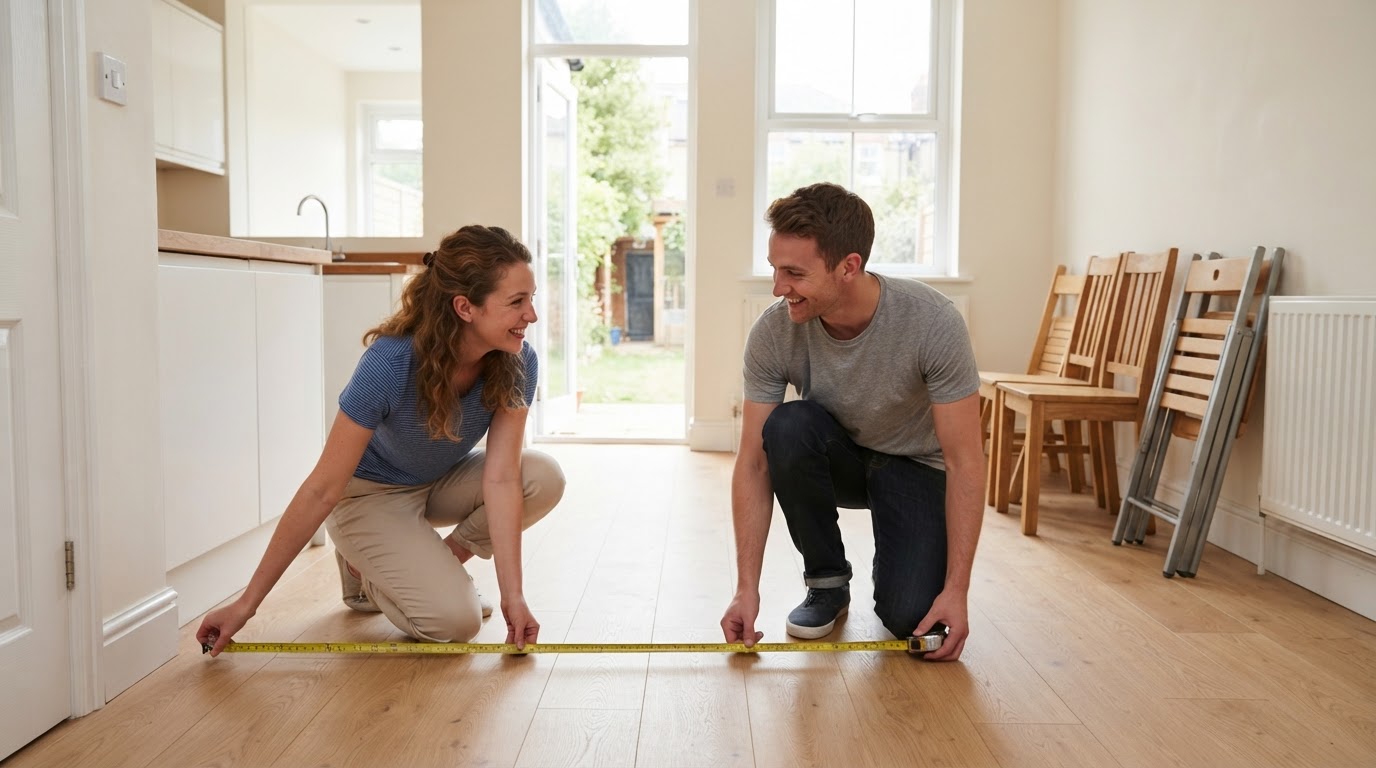
Dunelm’s guidance is about 60 cm of table width per seat, at least 120 cm of length for a rectangular four-seater, and around 90 cm of clearance from walls and furniture (Dunelm, accessed October 2026).
The Megafurniture guide puts the space behind each chair at 90 to 100 cm.
Weight adds a second constraint. A solid marble top of 60 to 200 kg needs two people, so hallways, stair turns and door widths matter as much as the dining room itself (Aurino, updated August 2026).
Check table length and floor area
The tool below turns the number of diners into a minimum table length and the clear floor area around it, using the Dunelm figure of 60 cm per seat.
These are guideline minimums for rectangular tables. Rounder or chunkier bases, and chairs with wide arms, need more space than the result shows.
How much does a marble dining table cost in the UK?

Only two UK retail prices were confirmed on the product pages for this article, so they are best read as signposts rather than a market average.
- £399 (was £579) for a 120 cm marble-effect round table at Fishpools.
- £1,199 for a 160 cm Carrara-top table at Castlery.
The gap of £800 is not a like-for-like comparison, because the size, shape and base differ as well as the top.
It does show the order of magnitude. The Carrara-top table costs around three times as much as the marble-effect stone-top table in this sample.
Sealing costs time more than money, at roughly ten minutes a year according to Aurino, so the larger gap sits in the purchase price.
In Summary
A marble dining table is a good choice for a household that accepts coasters, quick wipes and an annual sealing job in exchange for real stone.
A marble-effect or sintered top suits a busier home better, provided the data sheet names the material and the listing does not blur it with solid marble.
Whichever top is chosen, measure the room first, plan for the weight and ask for the material in writing.
Common Questions
Can a stained or etched marble table be repaired?
Light stains on real marble can sometimes be drawn out with a bicarbonate of soda and water poultice left on for about 24 hours, according to Aurino. Etch marks are damage to the surface, so a stone specialist would normally re-hone the top. A damaged marble-effect finish usually cannot be re-honed.
Do marble dining tables need special chairs?
Not special ones, but the fit matters. Megafurniture suggests a table height of about 75 cm, a seat height of 45 to 48 cm and a gap of 28 to 30 cm between seat and tabletop. Thick stone tops and heavy aprons can reduce legroom.
Can a round marble table work in a small dining room?
Povison suggests a round top of 42 to 48 inches (about 107 to 122 cm) for rooms under 130 sq ft (about 12 sq m), preferably in a honed finish. A round shape removes corners, which helps in tight walkways.