
At a Glance
A reading chair looks small in a showroom and large once it is delivered to a one-bedroom flat.
Many buying guides rank styles and colours, yet few give a single dimension to plan around.
This guide starts from the floor instead, with measured examples, a walkway calculator and the fabric and fire-safety checks that decide how long the chair stays useful.
Which reading chair style suits a small UK flat?
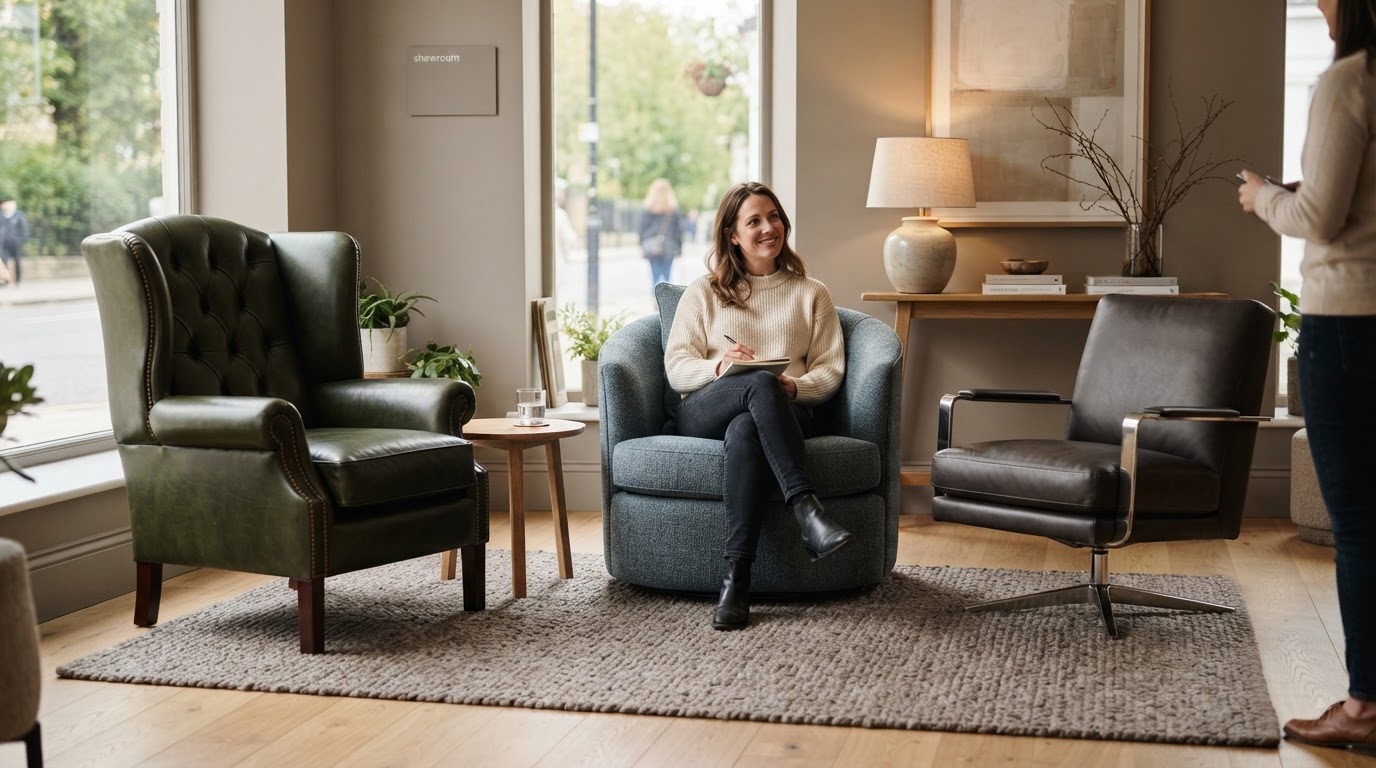
One UK retailer guide names five styles: the wingback, the deep tub chair, a chair paired with a recliner, the swivel chair and the statement armchair (Sofa Club, 14 October 2025).
That article gives no dimensions or prices, so the table below compares the styles on what each one changes in a small room. These are general characteristics, not measured figures.
| Style | Reading posture | Space consideration | Watch for |
|---|---|---|---|
| Wingback | Upright, head supported by the wings | Wings add visual bulk beside a window | Narrow wings suit tight corners better |
| Tub chair | Curled up, legs tucked | Deep, wide seat uses more floor | Check depth before falling for the shape |
| Chair with recliner | Reclined, feet raised | Needs extra depth when open | Measure the reclined length |
| Swivel chair | Upright, turns to window or lamp | Needs clearance to turn | Keep side tables out of the turning circle |
| Statement armchair | Varies with the design | Often the largest footprint | Style can outrank comfort |
A swivel chair or a slim tub chair usually leaves the most flexibility in a small room, because the seat can face a window, a lamp or the room without moving the furniture around it.
How much floor space does a reading chair take?
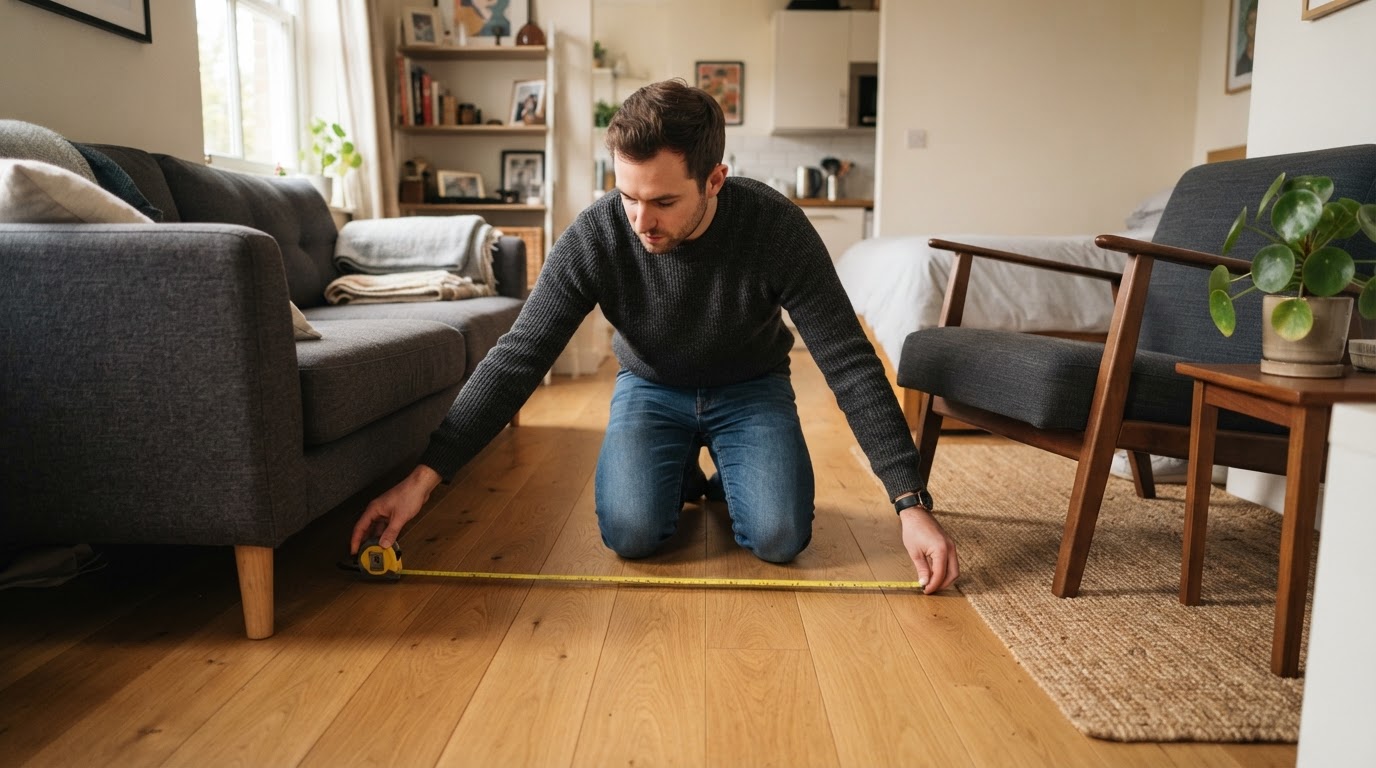
The average flat in England measures 60.3 m², down from 61.4 m² ten years earlier (Nationwide analysis of English Housing Survey data, 2023).
Two catalogue examples show how wide the range of reading chairs is.
- The high-back IKEA POÄNG armchair measures about 68 cm wide, 82 cm deep and 100 cm high, with a seat height of about 42 cm (IKEA product listing, accessed October 2026).
- The Original Chair Company reading chair measures 73 cm wide, 87 cm deep and 112 cm high, and needs 5 metres of fabric (accessed October 2026).
Multiplying width by depth gives roughly 0.56 m² for the first and 0.64 m² for the second (own calculation). Either one takes up about 1% of the floor of an average flat.
The footprint is rarely the problem. The clear passage around it is.
Catalogue depth is measured with the chair upright and empty. A footstool in front, a recliner in use or a swivel base turning through a corner all take more floor than the headline figure.
A design guide on small reading nooks advises leaving at least 30 inches (76 cm) of clear passage (Homestyler, 5 December 2025).
Typical case, illustrative: in a studio with 180 cm between the wall and the back of the sofa, a chair 82 cm deep leaves 98 cm of walkway. Adding a 40 cm footstool cuts that to 58 cm, which is below the 76 cm figure.
The calculator below runs the same sum with the measurements of any room.
Check what is left of the walkway
Enter the room measurements and the chair dimensions from the product page. The tool subtracts the chair, footstool and recline depth from the available space and compares the remainder with the 76 cm guide.
Which seat dimensions suit long reading sessions?

The same Homestyler guide aims for a seat height of 16 to 18 inches (41 to 46 cm), a seat depth of 18 to 21 inches (46 to 53 cm) and an overall width of 28 to 34 inches (71 to 86 cm).
The IKEA POÄNG, at 42 cm seat height, sits inside the seat-height range.
Its 68 cm overall width is slightly narrower than the 71 cm lower limit, and its published depth of 82 cm is the overall chair, not the seat.
Those are averages. A taller reader may need a deeper seat, and a shorter one may find the same seat leaves the feet dangling.
Sit fully back with the feet flat on the floor. The edge of the seat should stop short of the back of the knees, and the head should rest on the back or wings without the neck tilting forward.
Trying chairs in person is a useful complement to any measurement. A UK Living Made Easy factsheet on choosing a chair recommends testing several, since small differences in backrest angle or armrest position change how a chair feels (accessed October 2026).
Which Martindale rating suits a reading chair?
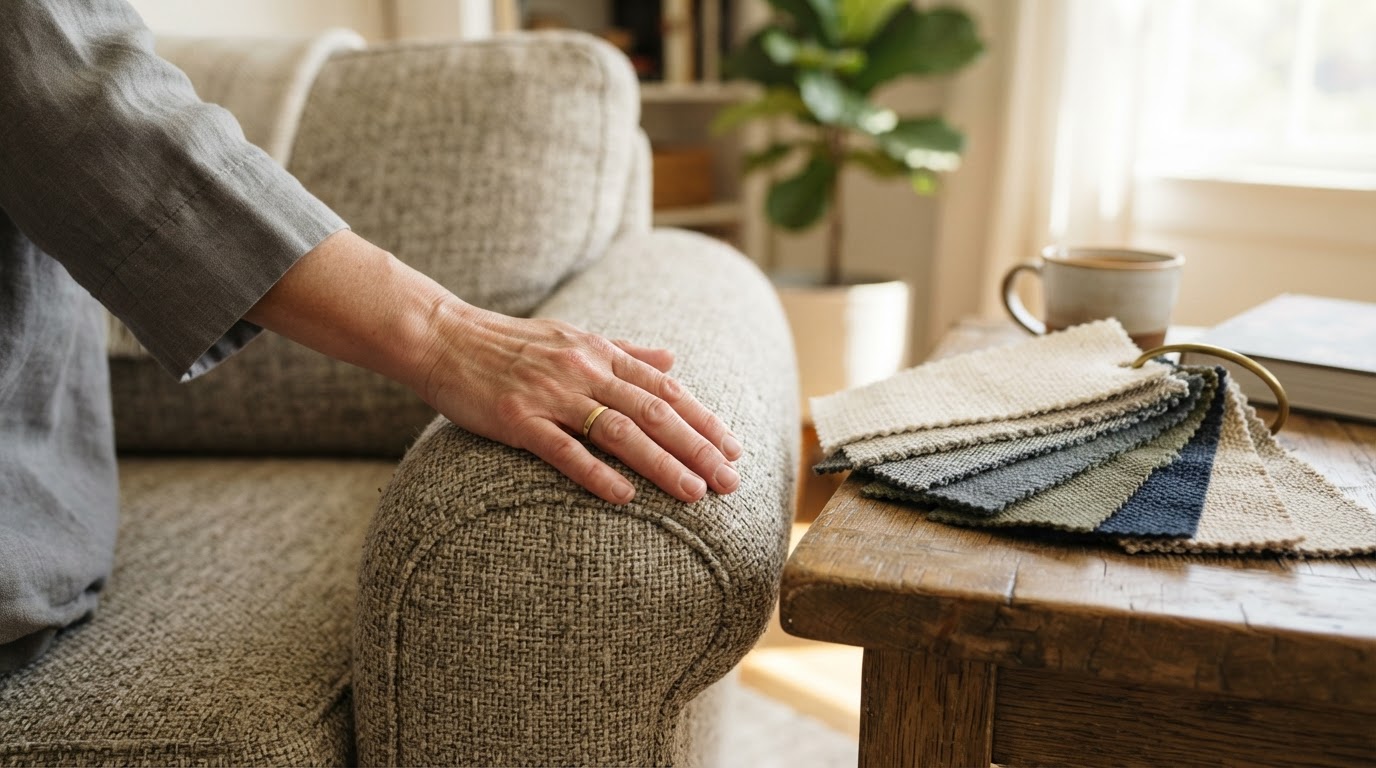
The Martindale test counts how many rubs a fabric withstands before it wears through. Higher numbers mean a more hard-wearing cover.
One UK fabric supplier lists 10,000 to 15,000 rubs as light domestic use, 15,000 to 25,000 as general domestic use and 25,000 to 30,000 as heavy domestic use (The Millshop Online, reviewed August 2026).
A chair used daily for an hour or two of reading sits closer to general domestic use than to an occasional spare-room seat.
Suppliers draw the band edges in slightly different places, so other lists may show different figures. The rub count on the product page matters more than the band name.
Made-to-order chairs make fabric a separate decision. The Original Chair Company lists fabrics from about £54 to £180 per metre for a chair that needs 5 metres (accessed October 2026).
The same maker quotes a lead time of 8 to 10 weeks, so a made-to-order chair needs planning well ahead of a move.
Does a reading chair need a fire safety label?
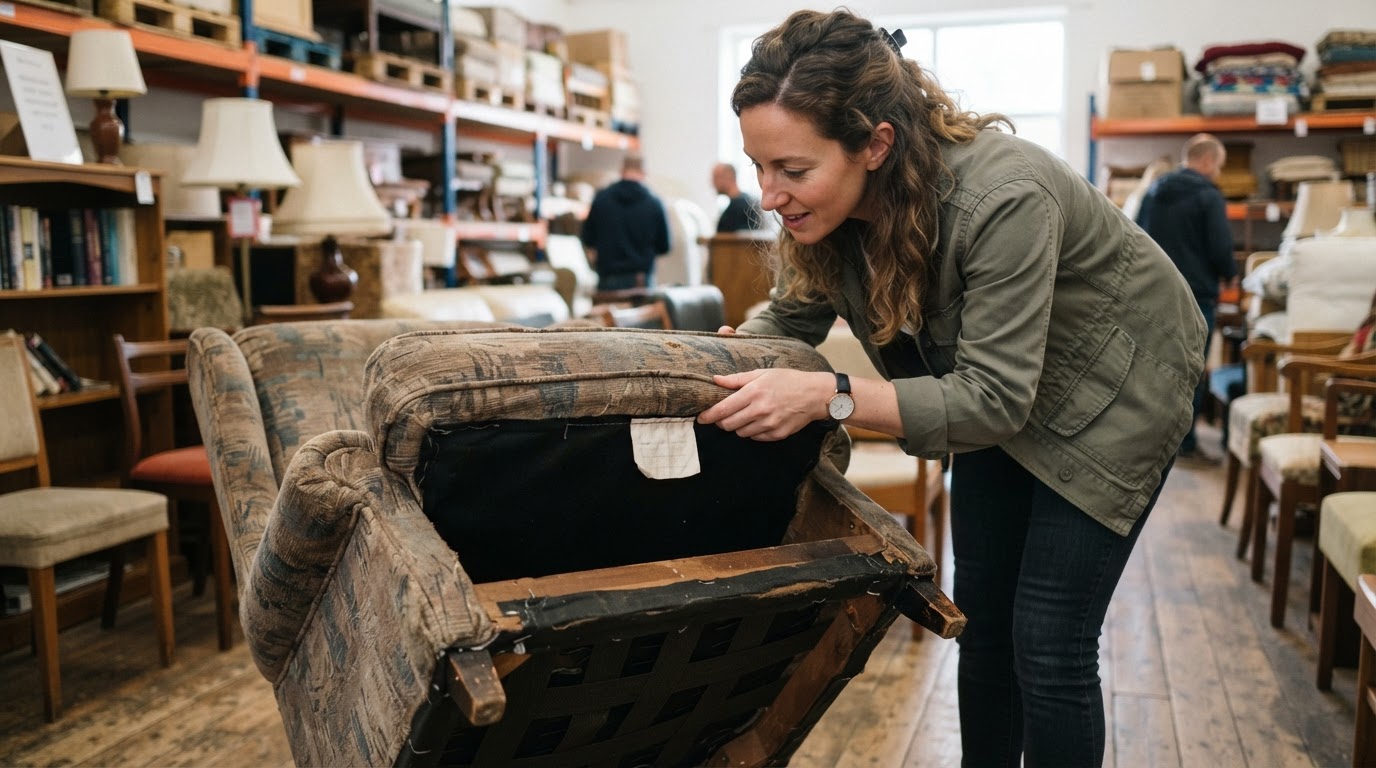
Upholstered furniture supplied in Great Britain for home use falls under the Furniture and Furnishings (Fire) (Safety) Regulations 1988 (legislation.gov.uk, accessed October 2026).
The regulations set a cigarette test and a match test, and require a permanent label on covered furniture, with exceptions such as mattresses and bed bases.
Furniture made before 1950 is excluded, and the regulations contain a separate section on second-hand furniture.
Look for the permanent label, usually under the seat cushion or on the back frame, before paying for a second-hand chair. A missing label is a reason to ask the seller, or Trading Standards, before buying.
What should be checked before buying a reading chair?

Many returns can be avoided with a handful of measurements that take about ten minutes to check.
- Measure the space from the wall to the nearest furniture, then subtract the chair depth, footstool and recline length.
- Check the remaining walkway against the 76 cm guide, using the calculator above.
- Compare seat height, seat depth and overall width with the ranges in the seat section.
- Look up the rub count and keep the use in mind: daily reading points to general domestic or above.
- Confirm the permanent fire label, or ask for it in writing for second-hand pieces.
- Measure the doorway and hallway, then ask about lead time for made-to-order chairs.
Typical case, illustrative: a bedroom corner with a 120 cm free wall suits a 68 cm chair, leaving 52 cm for a side table and lamp. A 73 cm chair leaves 47 cm.
A rug under the front legs can also anchor a corner. The guide on budget rugs for a UK living room covers sizing.
Another guide applies the same footprint thinking to kit that actually fits in a small UK flat.
A reading corner also needs something on the wall, and wall art ideas for renters keep the deposit safe.
In Summary
A reading chair rarely fails on footprint. It fails on the walkway left around it, the seat that does not suit the reader and a cover that wears out early.
Working through the depth sum, the seat ranges, the rub count and the fire label before buying removes most of those risks.
Common Questions
Is a recliner a good reading chair for a small flat?
It can be, if the reclined length is measured rather than the upright one. One retailer pairs armchairs with recliners as a combination (Sofa Club, 14 October 2025), but the extra depth only works where the walkway still clears 76 cm with the footrest open.
How far should a side table sit from a reading chair?
A design guide suggests 16 to 18 inches (41 to 46 cm) between the chair and the side table for easy reach (Homestyler, 5 December 2025). In a tight corner, that gap comes out of the same wall length as the chair width.
What height should a footstool be for a reading chair?
The same guide suggests a pouf 16 to 18 inches (41 to 46 cm) high, which works as a footrest and as an extra seat (Homestyler, 5 December 2025).