
At a Glance
A shoe bench solves two hallway problems at once: somewhere to sit while putting shoes on, and somewhere to keep them off the floor.
In a narrow UK hallway it can also create a third problem, which is less room to walk.
Most buying guides rank each shoe bench by style and price. Few say how much floor is left once one is in place, and that is the question that decides whether it works.
This guide does the sum with real dimensions, then covers storage types, how many shoes a bench really holds, and the checks that matter in a rented home.
How much walkway does a shoe bench leave in a narrow hallway?
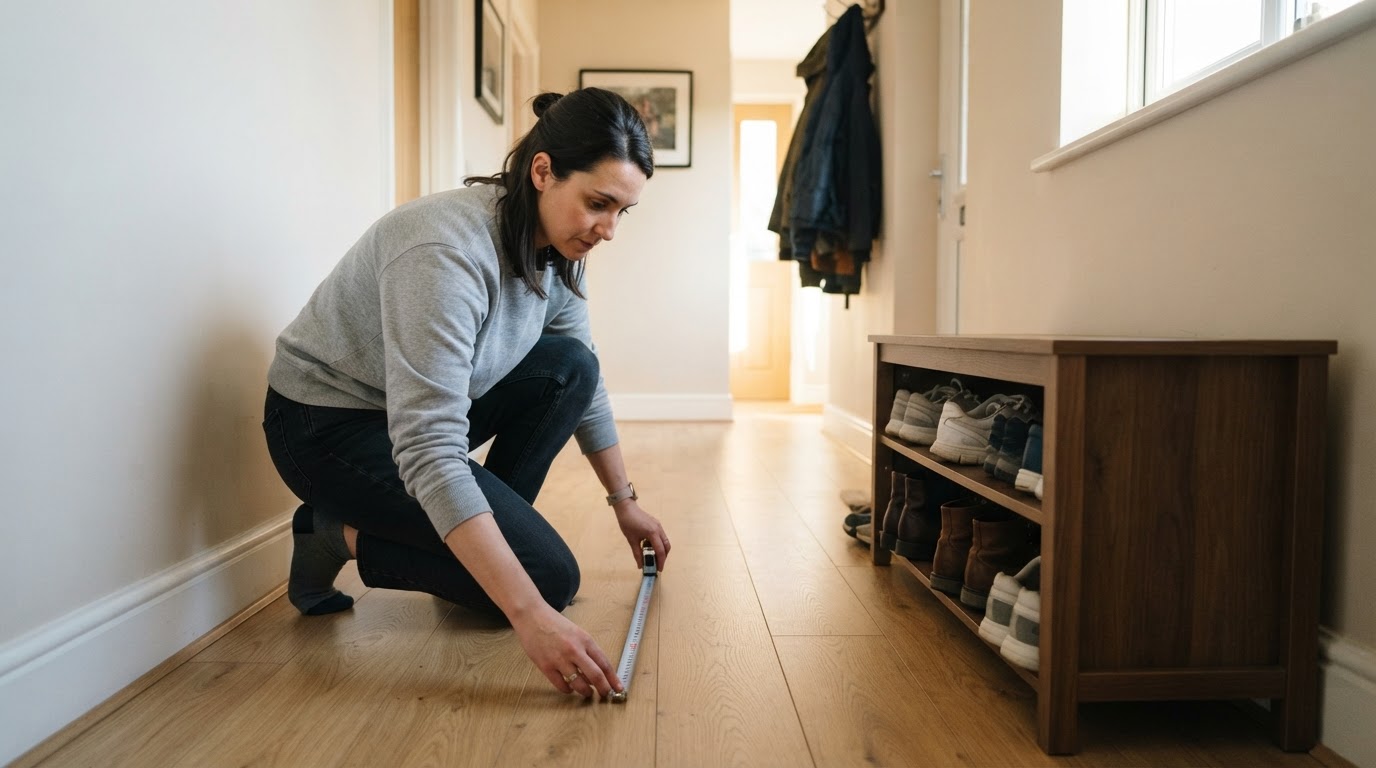
A bench takes its full depth out of the hallway’s width. A 35 cm deep bench in a 120 cm hall leaves 85 cm.
That figure ignores a front door swinging open, a coat on a hook, and the knees of someone sitting down to tie laces.
A useful yardstick comes from the Lifetime Homes design standard. It sets the minimum width of a hall or landing in a dwelling at 900 mm, provided the doorways have adequate opening widths (Centre for Accessible Environments, accessed October 2026).
The same standard lets the width drop to 750 mm at a pinch point such as beside a radiator, as long as the narrower spot is not opposite or next to a doorway.
These are design figures for new and accessible homes, not a rule that applies to an existing terrace or flat. Older UK hallways are often narrower, so the 90 cm line works as a comfort test rather than a pass or fail.
The sum is simple: hallway width minus bench depth equals the walkway left. Compare the result with 90 cm, or 75 cm beside a radiator.
Test your own hallway in three inputs
The calculator below takes the width of the hall at its narrowest point and the depth of the bench, then compares the walkway left with the 90 cm and 75 cm yardsticks.
Which shoe benches fit a narrow hallway?
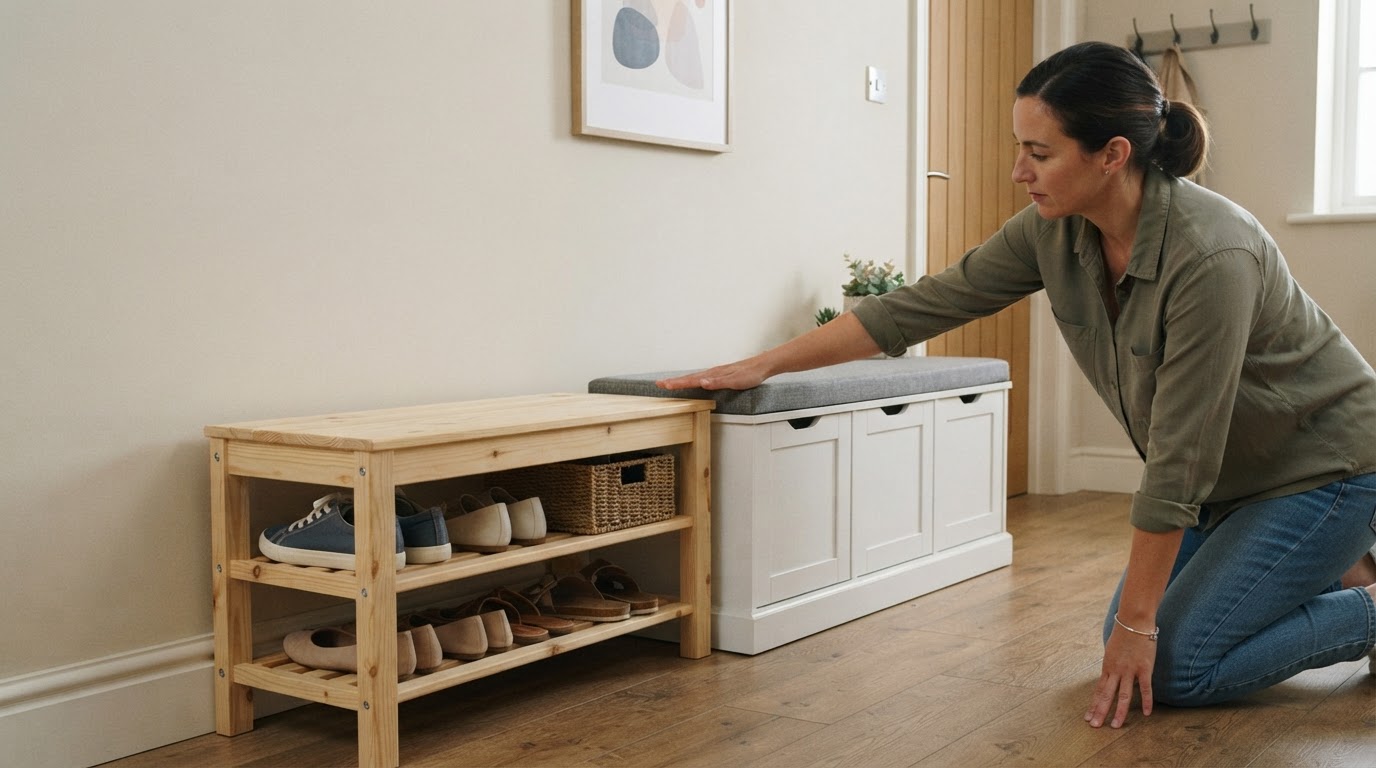
IKEA UK’s hallway bench range (accessed October 2026) shows how little depth varies between models.
The table adds two columns the product pages leave out: the hall width each bench needs to keep a 90 cm walkway, and the width needed beside a radiator at 75 cm.
| Bench | Size W x D x H (cm) | Listed price | Hall width for 90 cm walkway | Hall width for 75 cm walkway |
|---|---|---|---|---|
| NIPÅSEN | 79 x 35 x 52 | £39 | 125 cm | 110 cm |
| RAGGBERG | 60 x 35 x 45 | £25 | 125 cm | 110 cm |
| TJUSIG | 108 x 34 x 50 | £69 | 124 cm | 109 cm |
| KALLSÖ (with shoe storage) | 80 x 38 x 56 | £69 | 128 cm | 113 cm |
Depth only ranges from 34 to 38 cm, so the model matters less than the hallway. Below roughly 125 cm, none of these keeps a 90 cm walkway.
Capacity differs more than size. Compact Home’s guide (24 September 2026) puts NIPÅSEN at about 4 pairs of shoes with a 100 kg maximum tested load, and RAGGBERG at about 3 pairs.
In a hall under 125 cm, look for slimmer designs rather than a compromise on the walkway. One narrow model listed by Argos (accessed October 2026) is 104 cm wide and only 24 cm deep, which leaves 76 cm even in a 100 cm hall.
Open shelves, flip-down drawers or closed doors: which storage works best?
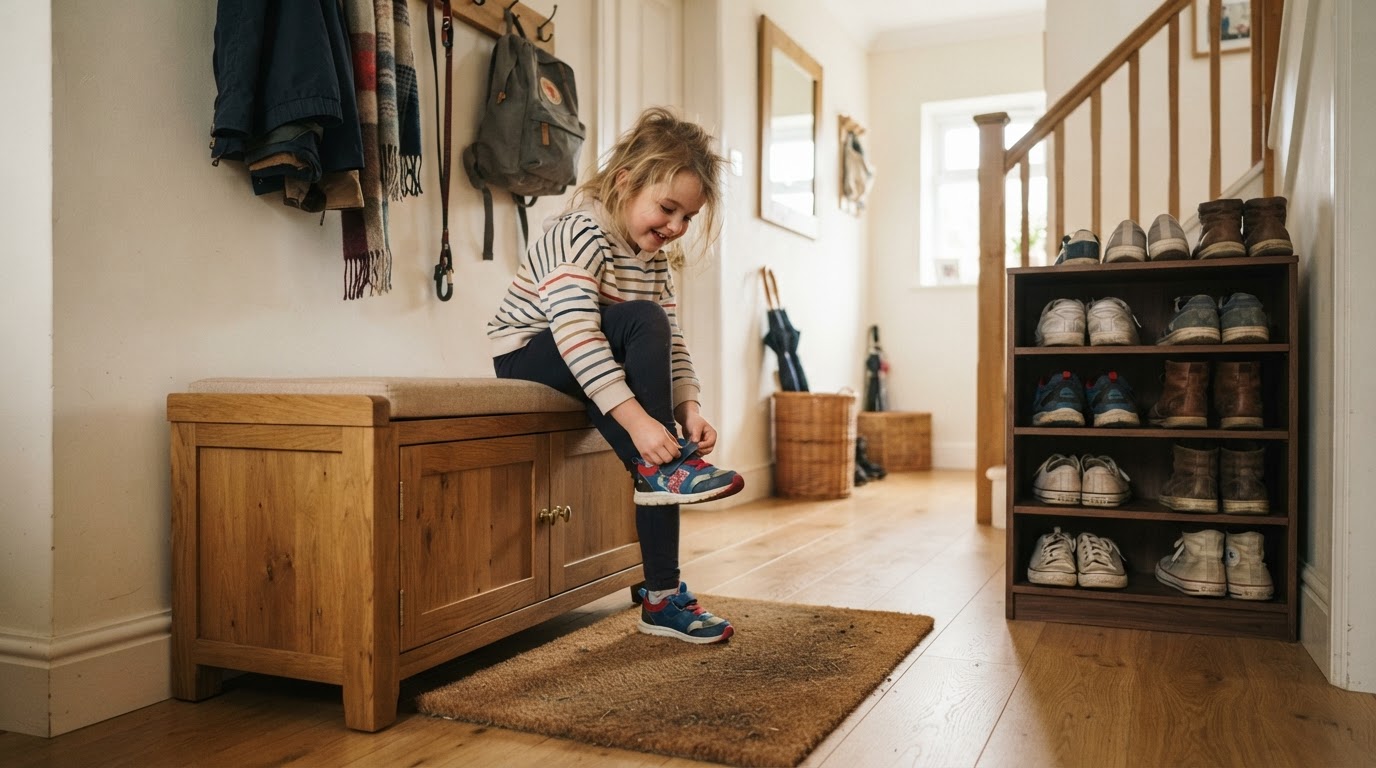
Open shelves are the quickest to use, but every pair is on show, so a busy hall looks cluttered fast.
Flip-down drawers hide the shoes and keep the footprint small. Each compartment is shallow, though, so boots and bulky trainers rarely fit.
Closed doors tidy the most. On Reddit (r/AskUK, 9 August 2025), a user says: “We have a shoe bench. Shoes get haphazardly stored in there but because it’s enclosed it doesn’t look messy.”
That is one household’s view, but it matches the trade-off: closed storage hides disorder rather than preventing it.
- Hides mixed and mismatched pairs
- Keeps dust and pet hair off shoes
- Gives a flat, clean seat
- Damp shoes dry slowly inside
- Fixed compartment height limits boots
- Easy to overfill without noticing
Shoe size matters for hidden compartments. Compact Home (24 September 2026) reports that the Habitat Saffield’s concealed compartment takes shoes up to UK size 13, and that the bench holds about 4 pairs.
Wet shoes put straight into a closed compartment stay wet. Letting them dry on a mat first avoids a damp smell building up inside the bench.
How many shoes does a hallway bench actually need to hold?
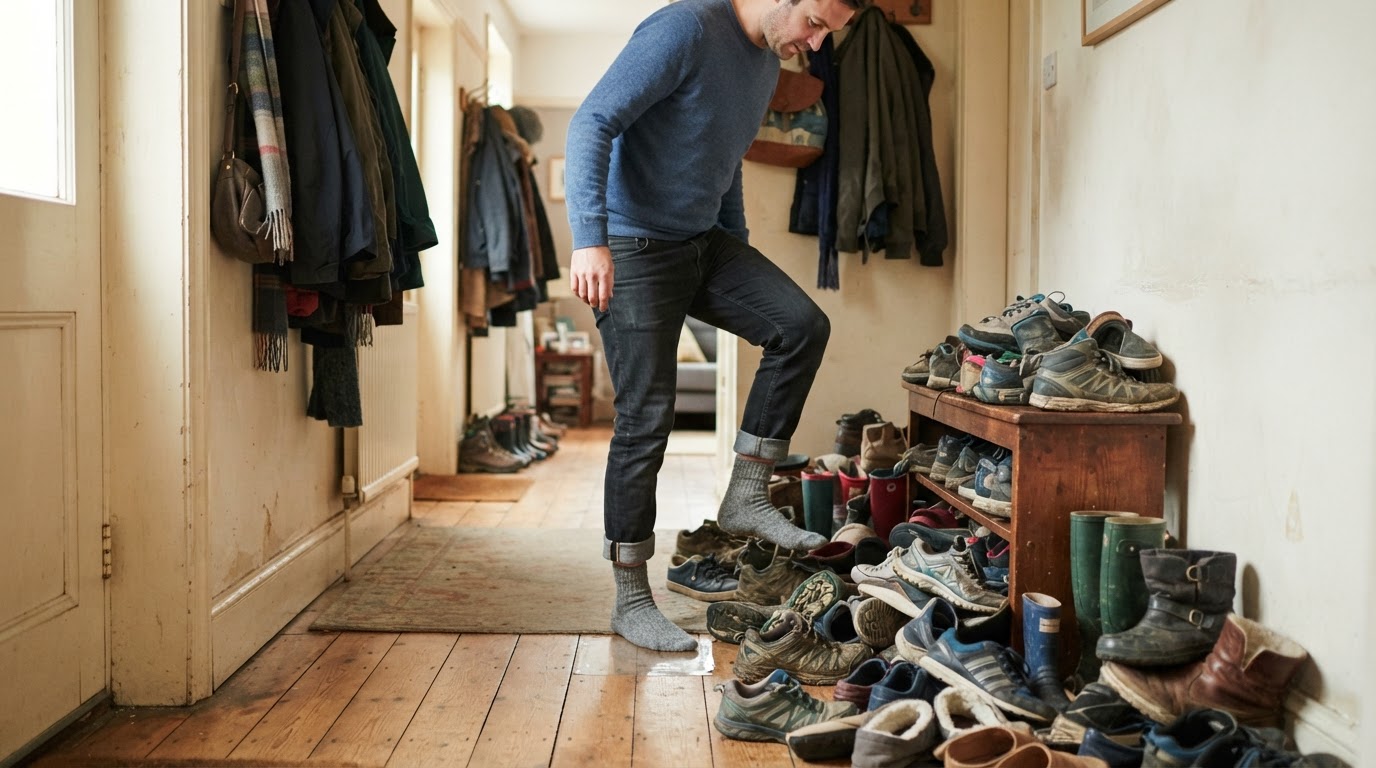
UK surveys disagree on how many shoes the average adult owns. Cordwainers puts the British average at about 12 pairs (accessed October 2026), while a Spartoo poll of 2,000 adults found 19 pairs for men (reported June 2017).
Not every pair belongs in the hall. A bench built for 3 or 4 pairs only works if the rest live somewhere else.
Two illustrative cases show the difference.
Typical case one: a single person in a one-bedroom flat who wears two or three pairs most weeks. A 3 to 4 pair bench covers the daily pairs, and the rest stay in the wardrobe.
Typical case two: a family of four with school shoes, trainers and wellies. A bench takes the seat role, but a separate rack or cupboard does the storing.
The overflow is easy to recognise. On Reddit (r/AskUK, 9 August 2025), a user describes “a lovely unit in the hall that’s supposed to store our everyday shoes but is always overflowing”.
Count the pairs worn in a normal week, then buy storage for that number plus one. Seasonal pairs belong elsewhere.
What should renters check before buying a shoe bench?
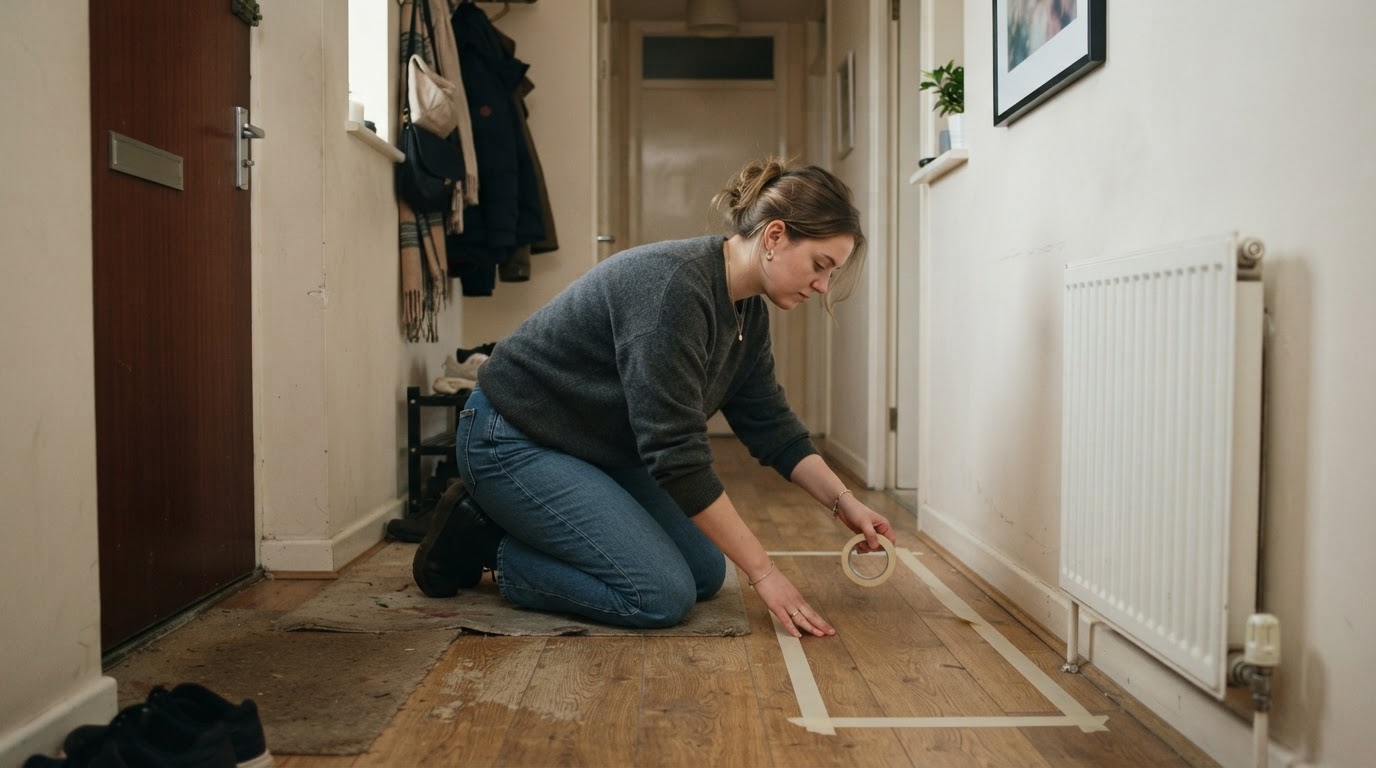
A freestanding bench needs no drilling, so there is nothing to make good at the end of a tenancy. That makes it a natural fit for a rented hallway.
The risk is buying one that does not fit. A few minutes with a tape measure and masking tape settles it before any money is spent.
- Measure the hallway width at its narrowest point, not at the front door.
- Stick masking tape on the floor to match the bench’s width and depth.
- Open the front door fully and walk the hall with a bag or laundry basket.
- Note where the radiator sits, because it counts as a pinch point.
- Check the listing for seat load rating and the largest shoe size that fits.
Product listings do not always agree with each other. Compact Home (24 September 2026) flagged a mismatch between a stated 80 cm width and a product link naming 100 cm, so the tape test beats trusting one number.
In Summary
A shoe bench is worth having when the hallway can spare its depth. Most current models are 34 to 38 cm deep, so the hallway width decides the answer.
Keeping a 90 cm walkway needs roughly 125 cm of hall, or about 110 cm beside a radiator. Slimmer designs of around 24 cm change that sum.
Storage type and shoe count come next. Closed benches tidy best, while a busy household usually needs a rack as well.
Common Questions
Can a shoe bench fit in a hallway under one metre wide?
Only a very slim one. A 24 cm deep bench leaves 76 cm in a 100 cm hall, which is below the 90 cm yardstick but close to the 75 cm figure for a pinch point. A standard 35 cm bench would leave 65 cm, so a wall-mounted rack is usually the better route.
How much weight can a shoe bench hold?
It varies and is not always stated. Compact Home (24 September 2026) reports a 100 kg maximum tested load for IKEA NIPÅSEN and a 130 kg seat rating for a HOMCOM model. IKEA’s category page (accessed October 2026) does not list load capacity, so check the individual product page.
Should a shoe bench sit next to a radiator?
It can, but with a gap. A radiator already narrows the hall, so the bench should not add to that pinch point opposite a doorway. Leaving space also stops shoes resting against hot metal.
Is a slim shoe cabinet better than a bench for a narrow hall?
A cabinet stores more shoes for the floor depth it uses, but it gives no seat. A bench suits households that sit to put shoes on, while a cabinet suits a hall where storage matters more than seating.