
At a Glance
A capsule wardrobe is meant to make getting dressed simpler, not to turn into another shopping list. Yet most guides stop at naming the pieces, without ever saying what they cost.
This one goes further. It sets out a realistic capsule wardrobe basics UK checklist, then puts real high street and mid-range prices against it, so the plan can actually be budgeted rather than guessed at.
It also covers the part most articles skip: British weather, which turns a simple “five tops, four bottoms” formula into something that needs an actual layering strategy.
What is a capsule wardrobe, and why does it suit UK weather?

A capsule wardrobe is a small, coordinated set of clothes chosen so that most pieces can be worn with most other pieces. Instead of dozens of outfits, you build a smaller pool of items designed to combine into many.
The idea suits unpredictable weather particularly well. A morning that starts dry can turn wet by lunchtime, and temperatures often swing across a single day. According to Statista, the UK has averaged around 156 days of rain or snow a year over the past three decades, though this varies sharply by region: London sees roughly 106 rainy days a year, while wetter areas such as the Lake District see closer to 200.
That regional gap matters. A capsule built for Cornwall or the Lake District needs a heavier-duty waterproof shell than one built for a drier city like London, even though both are nominally “UK weather”.
Before buying anything, check how many rainy days your specific region averages per year. A coastal or northern postcode usually needs a more serious waterproof shell than the UK-wide average suggests.
How many pieces do you actually need?

There is no single correct number, whatever some guides claim. A few rough frameworks are useful as starting points, not as rules to follow to the letter.
- The 5-4-3-2-1 rule: five tops, four bottoms, three dresses, two pairs of shoes, one coat or jacket, as a rough starter shape rather than a strict quota.
- The 3-3-3 rule: three tops, three bottoms and three pairs of shoes for a single, tightly defined season or trip, useful for travel or for testing the concept before committing.
- The 70/30 split: roughly 70% timeless, wear-anywhere basics and 30% trend-led or statement pieces, so the wardrobe stays personal rather than sterile.
Style guides such as Trilogy note that most people think of a capsule wardrobe as running to around 30 to 40 pieces, while suggesting 20 as a workable starting point to build up from. Treat any single figure as a range to work within, not a target to hit exactly.
None of these rules account for lifestyle. Someone working from home three days a week needs fewer smart-casual pieces and more comfortable layers than someone commuting daily into an office.
The core capsule wardrobe checklist, category by category

This is the practical starting list. Quantities are a guide, not a requirement, so adjust up or down based on the frameworks above and on your own routine.
- Tops: 2-3 plain cotton t-shirts, 1-2 long-sleeve tops, 1 crisp white shirt, 1 more casual shirt in a pattern or colour
- Bottoms: 1-2 pairs of straight or slim jeans, 1 pair of tailored trousers, 1 skirt or dress for smarter occasions
- Knitwear: 1-2 jumpers in neutral or versatile colours, 1 cardigan that layers over shirts and tees
- Outerwear: 1 waterproof or trench-style coat for three-season wear, 1 warmer coat for winter
- Shoes: 1 pair of trainers, 1 pair of ankle boots, 1 smarter pair for work or evenings
Two pieces from this list, worn together, should already produce several distinct outfits. A white shirt works under a jumper for the office, on its own with jeans at the weekend, and tucked into a skirt for something smarter, all from the same single garment.
What does a capsule wardrobe basics UK budget actually look like?

Most guides describe what to buy but stay silent on cost. Below are real UK prices for four core pieces, compared across a high street tier and a mid-range tier.
| Piece | High street example | Mid-range example |
|---|---|---|
| Plain cotton t-shirt | £8.50-£20 (M&S) | £28-£55 (COS) |
| Straight-leg jeans | £34.90-£40 (Uniqlo) | £65-£85 (COS) |
| Jumper | £39.90-£59.90 (Uniqlo cashmere) | £139-£229 (COS cashmere/wool) |
| Trench coat | £79-£95 (M&S) | £139-£269 (COS) |
Added together, these four pieces put a high street capsule basics UK starter, for just these categories, at roughly £162 to £215.
Go mid-range across the board and it climbs to roughly £371 to £638.
The gap is large enough that mixing tiers, rather than picking one exclusively, is usually the more realistic route.
Think in cost-per-wear rather than sticker price. A £95 trench worn 80 times a year works out cheaper, per wear, than a £40 coat that only gets pulled out a handful of times because it does not quite fit the wardrobe around it.
Estimate your own capsule budget
Pick a quantity and a tier for each category, then get an estimated total.
Buying new is not the only route into a capsule wardrobe basics UK plan. Second-hand and pre-loved options can lower the mid-range figures above substantially, at the cost of a less predictable size and condition range.
- Predictable sizing and condition
- Full returns policy if something does not fit
- Consistent stock of core basics year-round
- Sizing and condition vary between listings
- Specific sizes or colours can be harder to find
- Usually no formal returns process
Building your capsule for British weather: layering that actually works
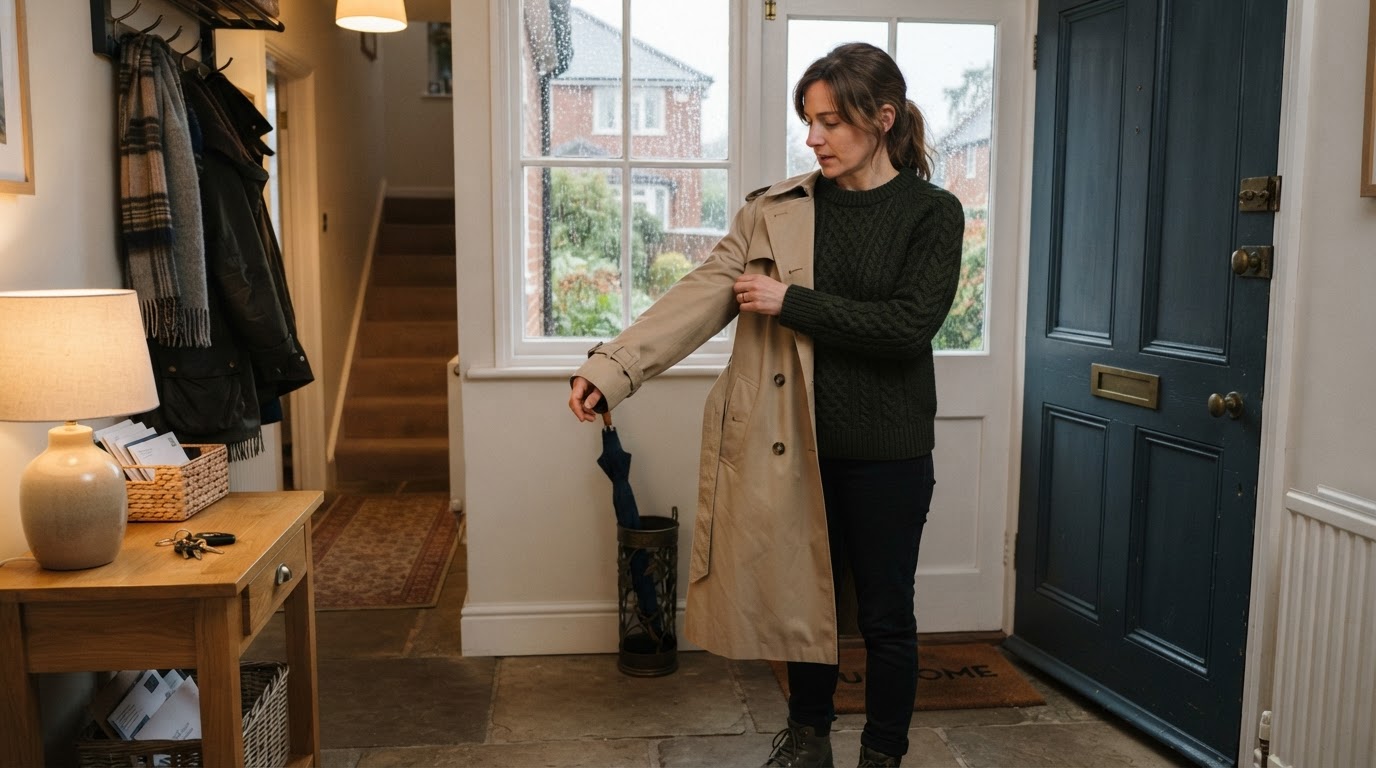
UK weather rarely calls for one warm item. Instead, it favours several thinner layers that can be added or removed as the day changes.
A workable system has three parts, layered together rather than swapped out one for another:
- Base layer: cotton or merino wool worn against the skin, breathable enough for indoor heating
- Mid layer: the jumper or cardigan from the checklist above, for insulation
- Outer shell: the trench or waterproof coat, chosen for weatherproofing rather than looks alone
The outer shell is the piece worth spending more on. A genuinely waterproof coat, not just water-resistant, holds up through a British autumn in a way that a fashion-first coat usually does not.
“Water-resistant” and “waterproof” are not the same thing. Water-resistant fabric holds off light drizzle for a short time; waterproof fabric is tested to keep out sustained rain. Check the product description, not just the marketing copy, before treating a coat as your one all-weather layer.
Footwear needs the same layered thinking. One genuinely weatherproof pair, even a simple pair of leather or treated-canvas boots, covers far more of the year than trainers that soak through at the first proper downpour.
How to audit what you already own before buying anything?

The cheapest way to build a capsule wardrobe basics UK plan is to start with what is already in the wardrobe, not with a shopping list.
Go through every item and ask three questions: does it fit properly right now, has it been worn in the last 12 months, and does it combine with at least two or three other pieces already owned.
Anything that fails all three is a candidate to remove, sell or donate.
Sort clothes into three piles: “wear regularly”, “fits but rarely worn”, and “does not fit or is worn out”. Only the third pile should leave the wardrobe outright; the middle pile often just needs restyling with a new piece rather than replacing.
This step matters more for cost than any single purchase.
Buying one £95 coat that actually gets worn is a better outcome than buying three £30 coats that each get worn twice.
Common capsule wardrobe mistakes to avoid

A few patterns show up repeatedly once people start building a capsule wardrobe, and most of them come from treating it as a shopping challenge rather than a styling one.
The first common mistake is buying “safe” basics out of obligation, rather than pieces genuinely liked.
Writer Maureen McLennon Welton described exactly this in her own capsule wardrobe experience: “I’ve bought many ‘okay’ shoes in the past. And that’s how I would keep accumulating more.”
She now applies a stricter test before buying: would she wear the item at least once a week? As she put it, “the stakes for purchasing become higher” once that question is asked first.
“Using this criteria, I’ve found making decisions on what to buy (or not buy) so much easier,” said Maureen McLennon Welton, describing her switch from impulse buys to a weekly-wear test.
A second common mistake is treating every piece as neutral. A capsule built entirely from black, white, navy and beige can end up feeling flat rather than versatile.
Following the 70/30 split from earlier keeps room for colour and personality without losing the mix-and-match logic.
A third mistake is buying the full list in one go.
Building it gradually, replacing worn-out pieces first and adding to gaps as they appear, spreads the cost and avoids ending up with items bought only to complete a set.
In Summary
A capsule wardrobe basics UK plan works best as a flexible range, not a fixed list, somewhere between 20 and 40 well-chosen pieces mixed across high street and mid-range tiers.
The weather layer matters as much as the pieces themselves: a genuinely waterproof outer shell, built around a breathable base and an insulating mid layer, does more for year-round wearability than any single standout purchase.
Start by auditing the wardrobe that already exists, then fill real gaps gradually rather than buying an entire list at once.
Common Questions
What is the 3-3-3 rule for a capsule wardrobe?
The 3-3-3 rule limits a capsule to three tops, three bottoms and three pairs of shoes for a defined period, such as a season or a short trip. It works well as a way to test the capsule concept on a small scale before committing to a full wardrobe overhaul.
What should a 70-year-old woman wear in a capsule wardrobe?
The same core principles apply at any age: well-fitting basics, versatile layering, and pieces that combine easily. What usually changes is the emphasis on comfort, fabric softness and easier-care materials, plus a wardrobe built around the activities and dress codes actually part of daily life, rather than a fixed age-based rulebook.
How much does it cost to build a capsule wardrobe basics UK from scratch?
Based on real UK prices for a cotton t-shirt, jeans, a jumper and a trench coat, a high street-only starting point lands around £162-£215, while a fully mid-range version costs roughly £371-£638. Most people land somewhere between the two by mixing tiers across categories.
Does a capsule wardrobe actually save money in the long run?
It can, but only if the pieces bought actually get worn regularly. A capsule built around a genuine cost-per-wear mindset, buying fewer, better pieces that combine into many outfits, tends to save money over time compared with frequent small purchases of items that rarely leave the wardrobe.
Is a second-hand capsule wardrobe a good alternative to buying new?
It can lower the cost of mid-range pieces significantly, since well-cared-for pre-loved garments from quality brands are often listed well below their retail price. The trade-off is less predictable sizing and no standard returns process, so it suits shoppers comfortable checking measurements carefully before buying.